

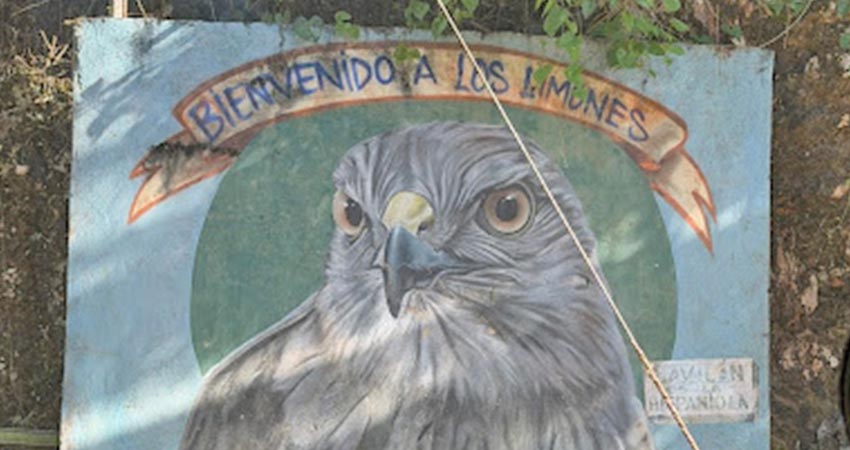
Los Limones: overview
The town of Los Limones, Monte Plata in the Dominican Republic is known for its agriculture and proximity to nature. The nearby conservation park Los Haitises is a vital habitat to the endangered Ridgeway Hawk that our partners at the Peregrine Fund have been working to protect since 2009. During our semester-long MIT class D-Lab: Development we designed a workshop to advance the work from the previous team’s visit and focused on the main issues the community wanted to address, as well as skills they believed would be helpful all stemming from the first workshop.

First workshop
We structured our first workshop to receive feedback and ideas from community members. We reviewed what they had learned the year before, progress on projects, and the ways they had applied their new skills to projects. What happened with the structures made the year before? What kind of issues or skills would they want to learn this year? From this conversation, three groups were formed: one to design chicken coops from locally available material, another for signage, and a group specifically focused on learning looming, crocheting, and knitting. In addition to these groups, we also had a co-design program for kids and a fumigation pole project intended to help rid Ridgeway's Hawk’s nests of botflies.
Chicken coop
The community is no stranger to the chicken coop issue. Chicken coops were proposed in order to help prevent Ridgway’s Hawks from hunting chicks, which would lead to people hunting the hawks.
Originally, the Peregrine Fund gifted cages, but they would often get sold, so we shifted focus to assisting the community to build their own chicken coops. Last year, the previous team showed the group how to make a yarn mesh for the chicken coop enclosure; however, it ended up not being as robust as needed. This year, we had the group build chicken coops out of locally sourced materials in conjunction with materials we brought. The group was very motivated to get a prototype finished and made two in two days! The first one consisted of reused wooden drawers with PVC supports and nylon thread. They also added a hinging door.
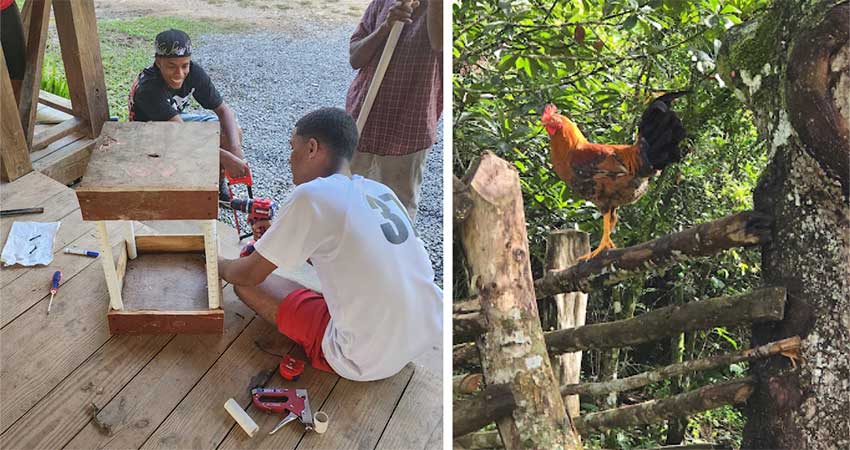
The second used PVC pipes and plastic mesh. Joining the corners of the PVC cage securely posed a slight challenge, but they devised a way by cutting parts from the ends of the PVC, which allowed them to be screwed together. The chicken coop turned out to be quite large. The group will now test their prototypes.
Looming, crocheting, and knitting
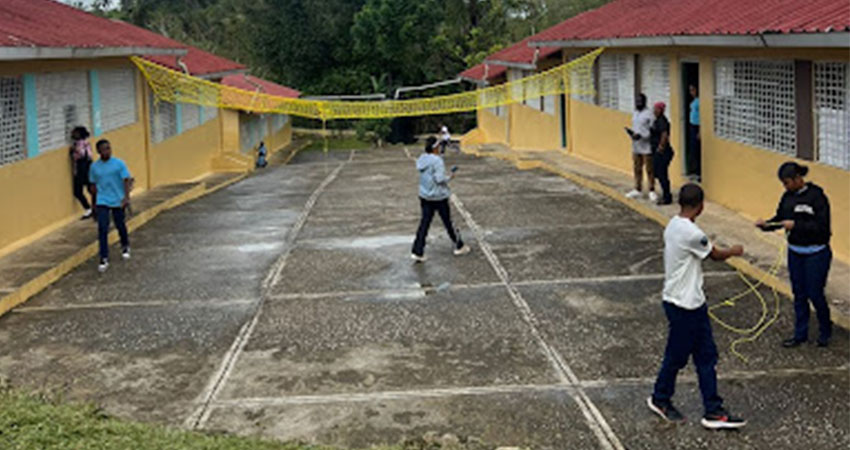
At our first workshop, we planned out some projects that we could work on: a volleyball net to replace the torn one at the school, a hammock, and a mat. We decided to start with loom knitting to continue on the work from last year’s group. The women built a simple loom using a wooden board with pencils as pegs, and the women iterated on the design, making additional looms with the pegs more spaced out for different projects that demanded larger stitches, such as for knitting hammocks.
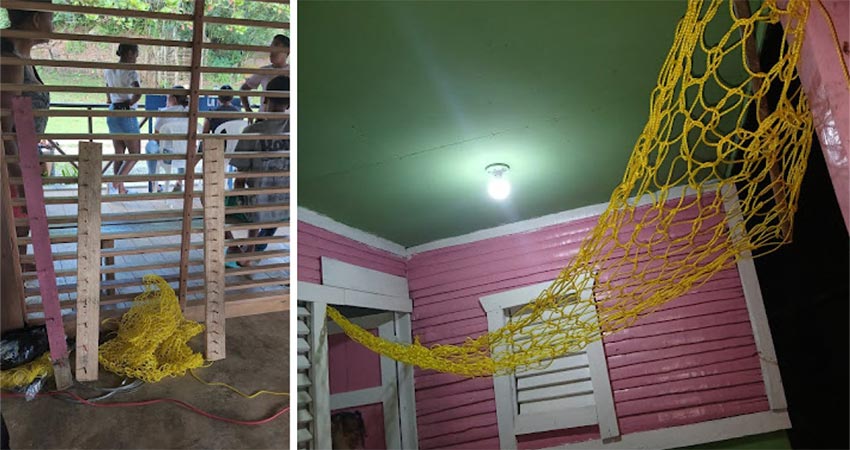
A lot of the women and kids were also interested in crocheting and knitting, so we showed them the basics of the two crafts. Many of the women and kids already knew how to crochet, so teaching crochet was very quick. Unfortunately due to limited time and materials, we were unable to show many people how to knit, but one of the ladies caught on quickly and learned how to knit and even perl! Thankfully there is a local store that sells the materials needed for the women and kids to keep practicing their craft.
Signs & waste management
In our initial workshop, after discussing the various issues they saw in the community, some community members brought up the idea of building signs across Los Limones to raise awareness about these issues. Soon, we organized workshops to go through the design process for signs with the group.
On the first day, we discussed what types of messages we wanted to have on the signs. Initially, many people were shy about engaging in the process, saying that they didn't know how to draw, or that they had bad handwriting—but as the group started getting more excited, the people who were initially shy started opening up and engaging in the design process, especially after seeing other community members they can relate to engage deeply in the design process.
On the second day, we started executing the plan, starting with cutting the wood pieces. Initially, we led the process by demonstrating the tools, but the group members quickly started taking the initiative, and soon, no longer needed our help. Some of the group members had experience and confidence working with tools from last year's workshop. Some of the newer participants were reluctant to work with power tools at first but soon gained confidence as well. There were also members of our D-Lab team who didn't have experience with power tools who took this opportunity to learn, so the learning experience was shared among all of us. After cutting, we treated the wood in order to address concerns of the group that the wood might rot in the rain and other elements, and left the pieces to cure overnight.
On the third day, we started assembling the treated pieces of wood, working with screws and nails. It played out similarly to the second day, with the group members initially shy about using the hammers and drill, but soon getting comfortable with the tools and assembling the signs with no additional direction from our team. An interesting development: We noticed that there a few men hanging around who started helping the women in the group, but rather than take over the assembly, they supported the women taking the lead in their work. In a community where it is more typical for men to work with tools, this role reversal was a promising sign that we were doing something to help shift the local perception of women’s roles in the community.
At the end of the third day, they figured out how they were going to finalize the signs, starting with pencil sketches, which they then soon started painting over at the start of the fourth day of workshops.
As they were discussing potential topics to feature on the signs, they brought up the issue of poor waste management, a very visible problem in Los Limones and other rural communities in the Dominican Republic. In many places, throwing out waste on the roads, local environment, and other public places is very normalized. As we probed further, we found that while there was a will to resolve the trash issue, and that people kept their homes tidy, there just wasn't an easy way to properly dispose of trash. The garbage truck comes once a week for the families on the main road, but semi-monthly for the families living off the main road. What's more, garbage bags are hard to come by, with most people using inadequate small plastic bags they get from stores.
The signs group, with some prompting from the students, started thinking about creating a system to facilitate trash collection in the community by creating communal trash collection points and public trash cans in the community.
Kids co-design
The curriculum began with an egg drop challenge on the first day to spark the children’s interest in design thinking and encourage them to make use of local resources. All the groups came up with great designs using leaves and trash, and most drops were successful! More than 30 kids showed up to the first workshop because of the excitement, and it was quite difficult to get everyone’s attention. Nevertheless, it was so heartwarming to see how happy the kids were when they found out their eggs were intact. It was particularly valuable to see their abilities to make use of their local resources for this challenge, which built the foundation for our later workshops.
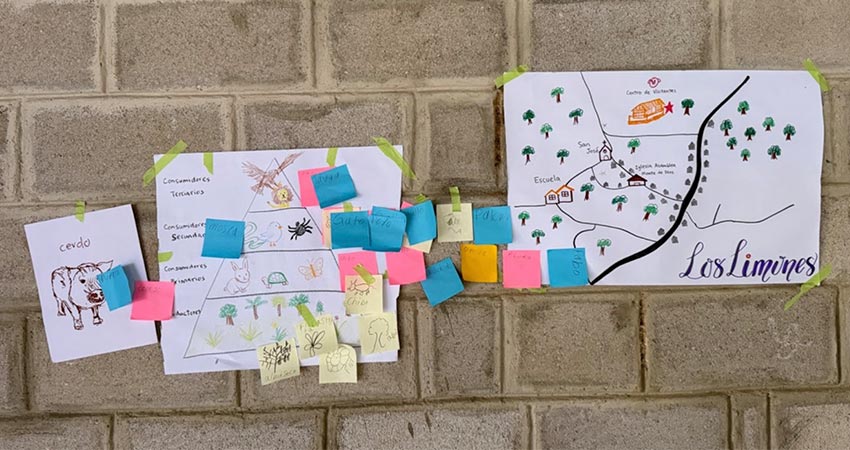
From Day 2 to Day 5, we started with general environmental education on the ecosystem and food chain and learned about plant growth. The kids each made their own plant using recycled plastic water bottles. Then, to help them internalize the knowledge with their local community, we did a plant/animal scavenger hunt within the town and had the kids place the items they found on the trophic pyramid.
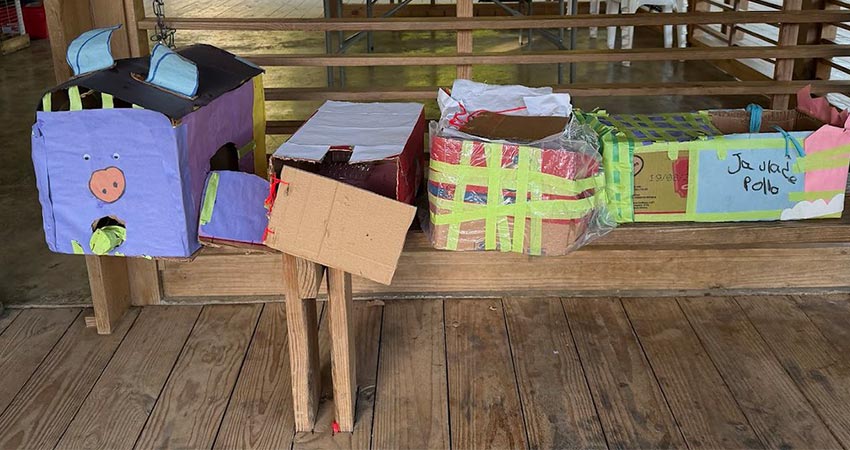
One thing we realized was the kids LOVED competitions! To tie in the design component of D-Lab’s pedagogy with their competitive nature, we had a chicken coop and trash can design challenge using recycled materials and other constraints. They initially struggled to come up with original thoughts and constantly asked us for help. After we encouraged them and refused to provide any guidance, they slowly started to get their footing and came up with many creative designs! One group even made their coop into the shape of a pig!
All the kids are super genuine and kind. They have been giving us small gifts since the first day (e.g. fresh almond and guava from the tree, handmade bracelets, flowers, cute drawings, etc.). During our chats, a lot of them mentioned that they dream of traveling and seeing more of the world. We visited the local school as well and learned that only around 10% of students end up going to college every year due to financial and geographical constraints. Most of them stay in Los Limones their whole life and work locally. It led us to reflect on how we can empower the younger generation more through educational enrichment and explore other ways to support them with their dreams.
Fumigation pole
Landing in Punta Cana, we saw the previous designs for fumigation poles by previous D-Lab classes and the Peregrine Fund and figured out the design improvements that could be made for each one. Soon, after learning about the design constraints from the Peregrine Fund (such as the height of the trees), we formulated a plan to create a pole to solve these issues—a very long telescoping pole, with a remotely-operated electric spray nozzle, camera, and light to fumigate the hawks’ nests.
Reflection and next steps
There were a few days when it quite literally rained on our parade, and we struggled to keep the attention of the kids. But overall, the workshops went well. We were able to use the co-design process to create things that are useful for the community and transfer the skills needed to independently make more. With the community, we were also able to design strategies to tackle systematic problems, such as access to tools and the waste management problem, which we hope can be successfully implemented by the time the next D-Lab team comes!
About the authors
- Emily Canales - MIT ’26. Emily studies Urban Planning & Studies at MIT with a focused interest in transportation planning and data visualization.
- Jasmine (Jiayu) Chen - Wellesley College ’27. Jasmine studies Environmental Studies and Data Science.
- Jelly (Angelica) Knudsen - MIT ’26. Jelly studies Mechanical Engineering with a focus on energy conversion engineering; on this project.
- Andraye Salazar - MIT ’28. Andraye studies Civil and Environmental Engineering at MIT.
More information
MIT D-Lab class D-Lab: Development
Contact
Libby Hsu, MIT D-Lab Associate Director of Academics