
Rapid, low-cost E. coli detection for drinking water in resource-limited settings, meeting WHO and UNICEF TPP performance benchmarks
MIT D-Lab class
D-Lab: Water, Sanitation, and Hygiene (EC.715/11.474) - Spring 2026
Community partner
Mitali Chowdhury (project mentor), Environment & Public Health Organization (ENPHO), EcoConcern
Project location
Kathmandu, Nepal
Team members
- Etash Bhat, MIT Undergraduate (Class of 2027). Etash is majoring in Biological Engineering and conducts research at the Yuyu Song lab at MGH on neurodegenerative disorders.
- Mayu Nakano, MIT Undergraduate (Class of 2027). Mayu is majoring in Brain and Cognitive Sciences, with a minor in Literature; she currently works in the Rakesh Jain lab at MGH on transcriptomics and animal behavioral studies in medulloblastoma.
Problem statement
Bacterial water contamination is a tremendous threat to developing nations. Diarrheal diseases kill approximately 1.2 million people annually, with a significant portion of deaths occurring among children under five years old in sub-Saharan Africa and South Asia. Nepal faces a particularly acute burden: diarrhea outcomes in children under five in Nepal are strongly associated with poor access to improved water sources and sanitation infrastructure, with rural and mountainous regions bearing disproportionate risk.
Background
Solutions to detect bacterial water contamination are generally expensive. The membrane filtration (MF) method, standardized by US EPA and WHO, involves filtering 100 mL of water through a 0.45 μm cellulose acetate membrane, which costs around $2 for the membrane alone. Other solutions, including electrochemical or molecular tests, pose similar monetary barriers for implementation in Nepal.
Prior work & project overview
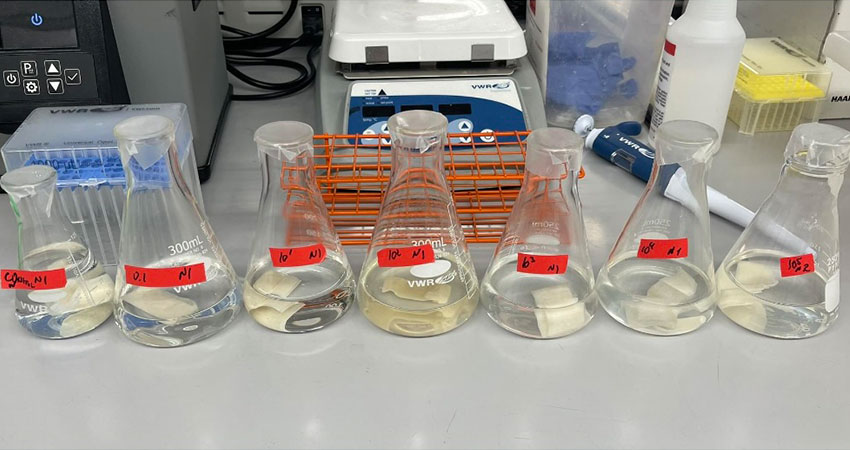
The ECC Vial is a low-cost, rapid method to detect bacterial water contamination; it was developed through a collaboration between two Nepali NGOs (the Environment and Public Health Organization (ENPHO) and EcoConcern) with support from MIT J-WAFS. The vial relies on the 5-bromo-4-chloro-3-indolyl-β-D-glucuronide (X-Gluc) enzyme to detect the activity of E. coli’s β-glucuronidase activity. In the presence of β-glucuronidase, the vial turns blue (positive). Otherwise, the vial remains colorless. The cost of this would be around $0.27 for the reagents, rendering it accessible to resource-constrained populations.
The WASH 2026 deliverables included re-scaling the 10mL ECC Vial to 100mL, with statistical validation and sensitivity testing. Future experiments can involve assessing the necessity of tryptophan, and improving on the container/incubation design.
More information
Contact
Mitali Chowdhury, Student Team Member