
Developing a low-cost, locally operable system to streamline post-harvest cocoa bean cleaning and drying for small-scale farmers by reducing manual labor and improving processing efficiency.
MIT D-Lab class
D-Lab: Design (2.722J / EC.720) - Spring 2026
Team
- Peyton Brown - MIT ‘27. Peyton is a third-year undergraduate student at MIT studying Brain and Cognitive Sciences and Philosophy.
- Kaylie Cornelius - MIT ‘27. Kaylie is a fourth-year undergraduate student at MIT studying Mechanical Engineering and Environment & Sustainability.
- Elise Echarte - MIT ‘27. Elise is a third-year undergraduate student at MIT studying Mechanical Engineering and Environment & Sustainability.
- Skye Williams - MIT ‘28. Skye is a second-year undergraduate student at MIT studying Mechanical Engineering and Architecture.
- Lizzie Yoon - MIT ‘28. Lizzie is a second-year undergraduate student at MIT studying Mechanical Engineering and Architecture.
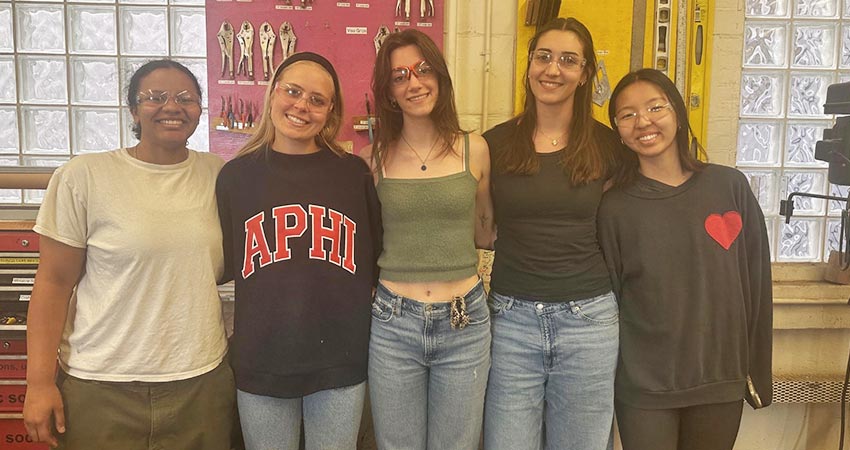
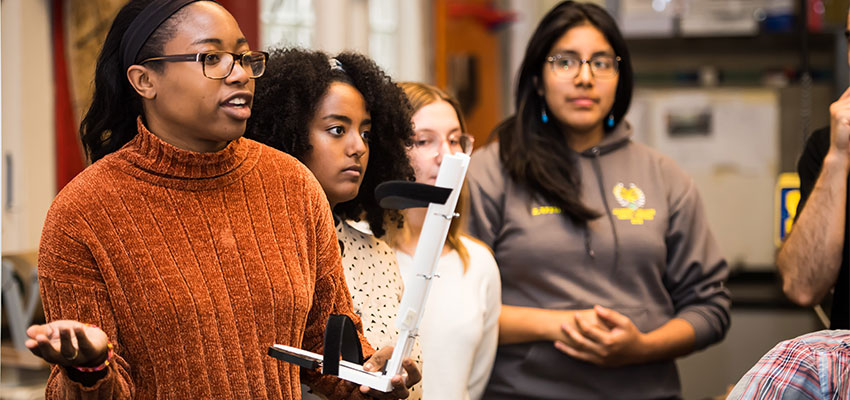
Lizzie Yoon. Photo: Courtesy MIT D-Lab
Community partners
- Jiayue Zheng - PhD Candidate in Economics at Brown University
- Yunyu Shu- Assistant Professor in Economics at Shanghai University of Finance and Economics
- Ruozi Song- Economist in the World Bank Sustainability and Infrastructure Team
- Ghana Cocoa Board in Nkawkaw
Project location
Ghana
Problem driving project
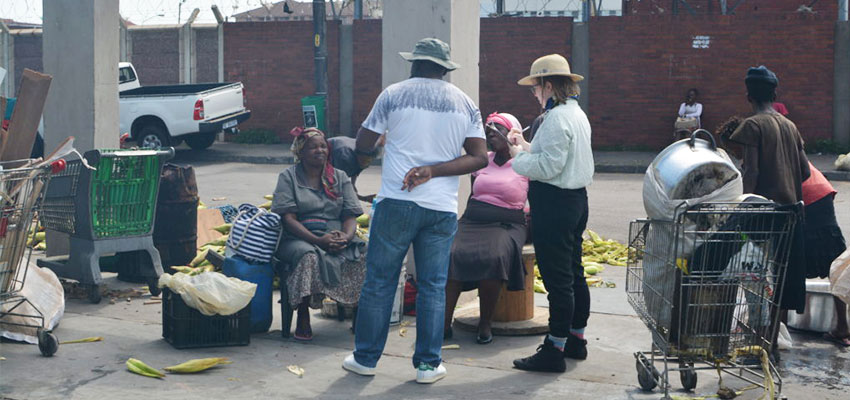
Ghana is the world’s second-largest cocoa bean exporter, and millions of Ghanaians rely on the cocoa sector for their livelihoods. However, climate change-driven weather variability has increasingly disrupted cocoa farming and post-harvest processing. Unexpected rainfall can delay bean drying, reduce cocoa quality, and decrease farmer income. Additionally, fermented cocoa beans retain fibrous material and a placenta layer that must be removed manually through repeated flipping, rubbing, and sorting over several days. This labor-intensive process requires workers to spend long hours outdoors in harsh sun and rain conditions while continuously turning beans to promote even drying and prevent
moisture buildup. Remaining fibrous material can also trap moisture, leading to inconsistent drying and reduced bean quality. As a result, there is a growing need for a low-cost, climate-smart processing solution made from locally available materials that can improve drying efficiency, reduce labor burden, and operate within small-scale farming systems without reliance on electricity.
Cultural context
Efficient drying is very important to cocoa farmer livelihoods in Ghana. We partnered with the Ghana Cocoa Board in Nkawkaw. The pilot prototype could first be tested with a selected farmers’ group and, if proven effective, potentially expanded to support more than 2,500 cocoa farmers in the Nkawkaw region.
Proposed solution
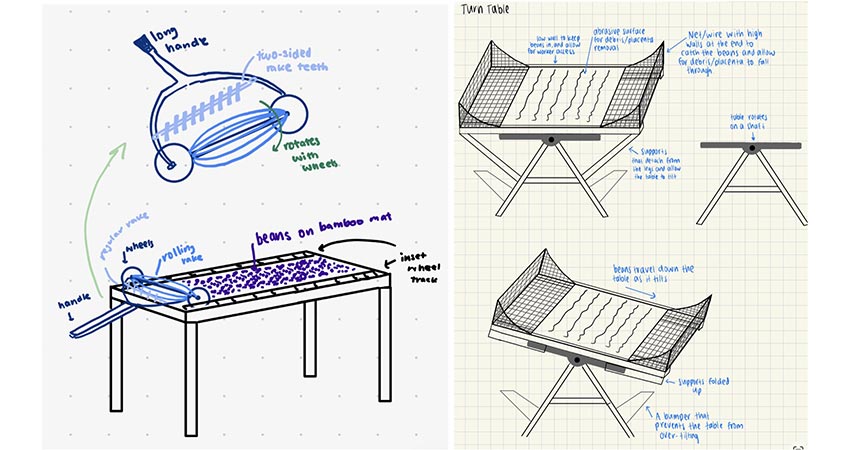
Through feedback from project partners, cocoa extension officers, guest lecturers, and community members, our team developed a bamboo drying table addition paired with a dual-purpose rolling rake system designed to improve cocoa bean processing and drying efficiency.
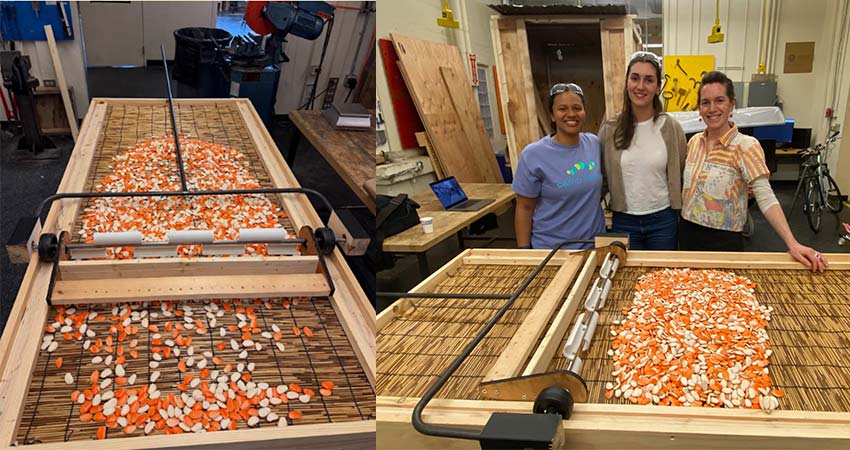
The table addition incorporates wheel tracks and side walls along the drying surface, allowing the rolling rake to move smoothly across the table while flipping and redistributing cocoa beans. The rolling rake features three main components:
- A front rotating rake that flips beans through a scooping-and-rotating motion
- A rear pronged rake that levels and redistributes the beans after flipping
- A push stick connected to the rotating shaft for guided movement across the table
Together, these components are designed to help workers process larger quantities of cocoa beans with less manual labor and reduced outdoor exposure. More consistent flipping may also improve drying uniformity, reduce moisture buildup from unexpected rainfall, and help remove residual fibrous material from the beans.
Next steps
Our current physical prototype represents one iteration among several possible rolling rake designs and is currently operated manually using a push stick spanning the length of the table. Future iterations would explore converting the rolling mechanism into a bicycle-pedal-powered system, allowing users to remain seated (preferably under shade) while pedaling the rake across the table with reduced physical exertion. Additionally, future testing would evaluate the efficiency and effectiveness of our current rolling rake concepts by fabricating complete prototypes and comparing their performance using cocoa bean proxies. Following continued refinement and testing, we hope the final pedal-driven rolling rake system can eventually be implemented in cocoa farming communities in Ghana with support from future collaborators and project partners.
Contact
Eliza Squibb, MIT D-Lab Instructor
Peyton Brown, Team Member
Kaylie Cornelius, Team Member
Elise Echarte, Team Member
Lizzie Yoon, Team Member
Skye Williams, Team Member