

Langa, South Africa: Context
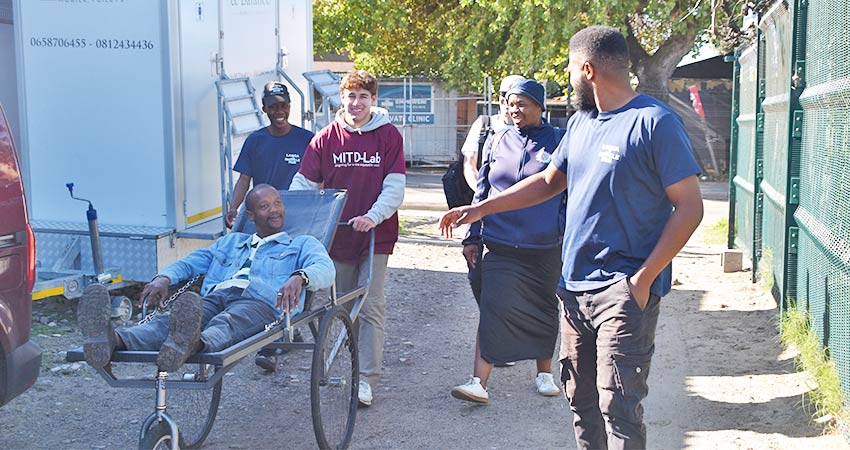
Located just outside of Cape Town, Langa is South Africa's oldest black township. Like many of its kind established during apartheid, its dense layout and limited infrastructure continue to shape daily life today. Narrow pathways, uneven terrain, and areas inaccessible to motor vehicles make transportation particularly challenging. In medical emergencies, this can make all the difference.
These geographic realities have been the driving force behind the mobile and portable REACH stretcher project developed through MIT D-Lab over the past several years. By enabling healthcare workers to transport patients and medical supplies more effectively, the project seeks to improve access to care while remaining practical for the environment in which it will be used.
Our team and goals
This iteration of the stretcher began in Spring 2026 as a class project in MIT’s D-Lab: Design (2.722J /EC.720). Taught by Ankita Singh and Eliza Squibb, the team consisted of Marco Arias II (MIT '26), Pauline Vien (MIT '27), Kayode Dada (MIT '27), Michelle Lam (MIT '27), and Ruben Stephen (MIT ’27), and culminated in the prototype eventually brought to the township.
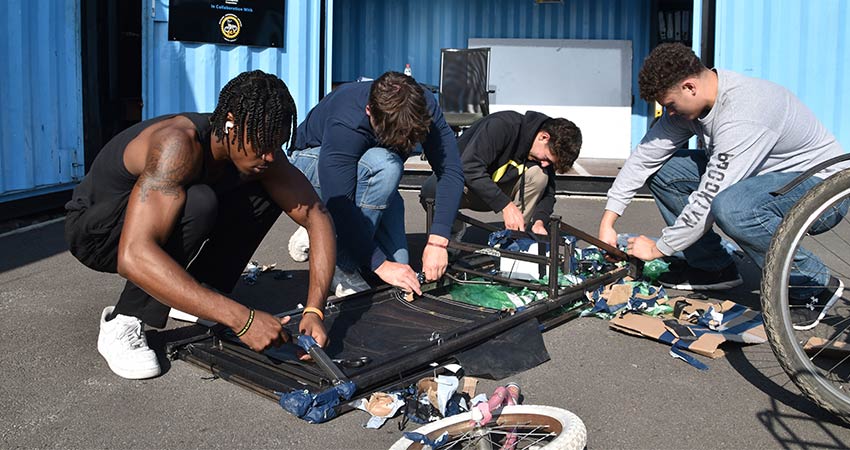
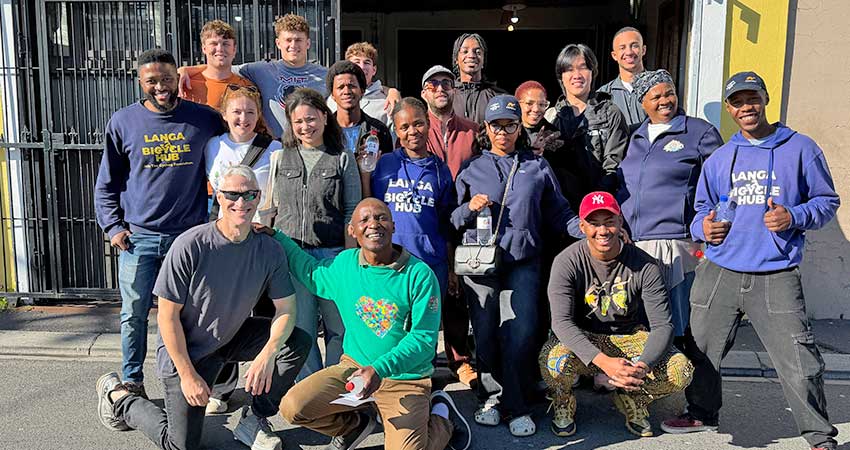
In June, a different lineup carried the prototype the rest of the way: trip leader Maddie Johnson-Harwitz brought Kayode Dada, Marco Baisch (MIT '29), Jaiden Cadotte (MIT '29), Luke Johnson (MIT '29), and Ruben Stephen (MIT '27) back to Langa to assemble, test, and collect feedback on the stretcher from the community that would use it. The team consisted of students in both D-Lab: Design and D-Lab's newest class, Introduction to Engineering Design for International Development, taught by D-Lab Founding Director Amy Smith, Martha Thompson, and Matthew McCambridge.
The project: co-design across time
The prototyping team in D-Lab: Design built upon the work of students in four previous D-Lab teams, each of whom contributed to the stretcher's iterative development through prototyping, testing, and community feedback. Rather than beginning with a blank slate, they continued a design process that had evolved over multiple years alongside our partners in Langa.
Based on feedback gathered during previous deployments, the primary design goals were twofold.
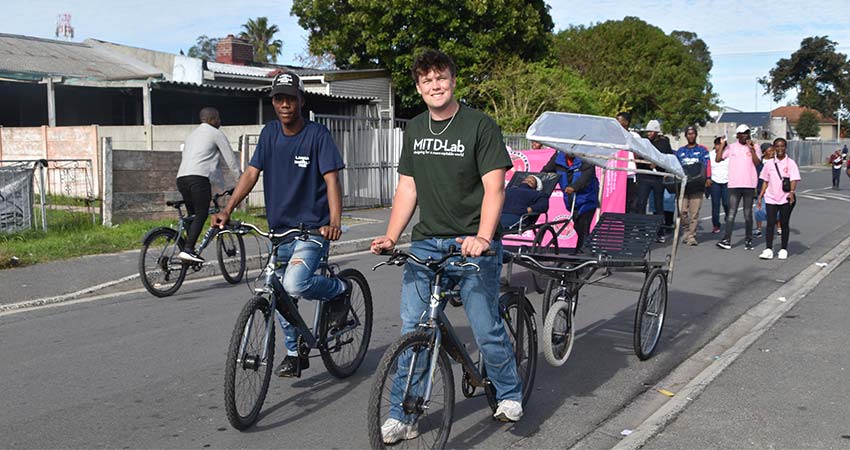
- First, to develop an attachment that allows the stretcher to be towed behind a bicycle when not carrying a patient, reducing the physical effort required to move it between locations.
- Second, to design a lightweight shade structure to provide additional protection from the sun during patient transport. Throughout the spring semester, these features were prototyped and refined before being brought to Cape Town for testing with community members.
Understanding Langa: stronger together
Beyond the engineering work itself, one of the most memorable aspects of our time in Langa was seeing how deeply collaboration is woven into the community.
Organizations throughout the township demonstrated how shared resources and strong local partnerships create opportunities that extend far beyond their primary missions. At Mzansi Restaurant, meals were paired with performances from local musicians, creating a space that celebrates both food and culture. At the Langa Bicycle Hub, bicycle repair operates alongside educational programming and community initiatives that serve residents of all ages.
This same spirit of collaboration was evident throughout our project. Community organizations, healthcare workers, manufacturers, and local leaders each played a unique role in moving the project forward. Rather than existing independently, these partnerships reinforced one another, making it possible to accomplish far more collectively than any one group could alone.
Project partners
The success of this project depended on collaboration with organizations throughout Langa and Cape Town.
The Langa Bicycle Hub served as our primary community connection, helping coordinate outreach, facilitating conversations with residents, and providing insight into how the stretcher could be integrated into existing transportation networks.
Our healthcare partners at Kheth’Impilo shared their day-to-day experiences providing care throughout Langa. Their feedback helped us evaluate design decisions through the perspective of the people who would ultimately use the stretcher most frequently.
A partnership that was formed by the REACH team with Shonaquip Social Enterprise allowed us to tour their testing facilities and sit down for a meeting with Shonaquip’s founder, Shona McDonald, and her design team. Shona shared advice on how to scale and integrate the project into existing systems, giving insight on public health policy in South Africa, what to include in a go-to-market plan, and how she has worked with the government to distribute assistive technology across the country. In meeting with the design team, we dove into the feedback we had received on the most recent stretcher prototype, spending time collectively sketching ideas for the next iteration. Their experience designing equipment for challenging environments provided valuable feedback that informed our thinking around comfort, ergonomics, and usability.
We also partnered with GM Technologies, where components of the updated design were manufactured from our team’s technical drawings - our university-built prototype was translated into a professionally manufactured product. The visit highlighted another important aspect of engineering: designing not only for functionality, but also for manufacturability, durability, and long-term maintenance. Creating a successful prototype is only one step; ensuring that it can be built, repaired, and sustained locally is equally important.
Beyond the prototype: deployment systems
One of the most valuable lessons from this trip was that successful engineering extends well beyond the prototype itself.
During community feedback sessions, we repeatedly heard stories about government-issued motorbikes that had been introduced to improve healthcare access but ultimately saw little use. Although the technology itself was sound, community members explained that the program had been implemented without adequately involving the people expected to use it. As a result, the solution never became integrated into everyday practice.
Those conversations reinforced the importance of designing alongside community partners throughout the entire development process. Our healthcare partners at Kheth’Impilo, who navigate Langa's streets every day while caring for patients, continually provided practical feedback that shaped how we evaluated our own design decisions.
Looking forward
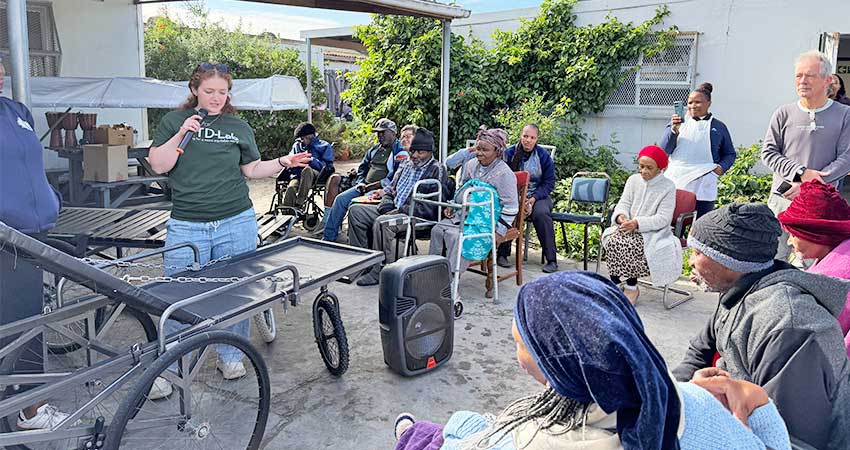
Testing the updated design with community members provided valuable direction for future iterations of the project. In a feedback session with disabled community members, the stretcher was tested by wheelchair users who requested handles to use to push themselves into a sitting position. The community healthcare worker’s main focus was the expansion of the shade structure beyond its current design, creating a tent-like enclosure that would provide more complete protection from both sun and rain during patient transport. Our team recorded these feedback sessions and the ideas brainstormed with community members.
Like the teams before us, our goal was not to produce a finished product, but to move the project one step closer to a long-term solution. By building upon previous work, testing ideas directly with users, and documenting feedback for future teams, we hope the next generation of D-Lab students can continue refining the design alongside our partners in Langa.
More information
REACH (Reliable Emergency Access to Community Health)
Building reliable emergency access in Langa, South Africa, Blog post | Jun 05, 2025 | Michela Galazzi and Madeleine Johnson-Harwitz, Massachusetts College of Art and Design ‘25
Improving emergency transport in Langa, South Africa, Blog post | Anna Duncan ‘25, Jack Grier ‘25, Avani Narula ‘25, Annica Lam ‘26, Michela Galazzi and Maddie Johnson-Harwitz
Contact
Libby Hsu, MIT D-Lab Associate Director of Academics
Maddie Johnson-Harwitz, REACH Co-Founder