

Overview
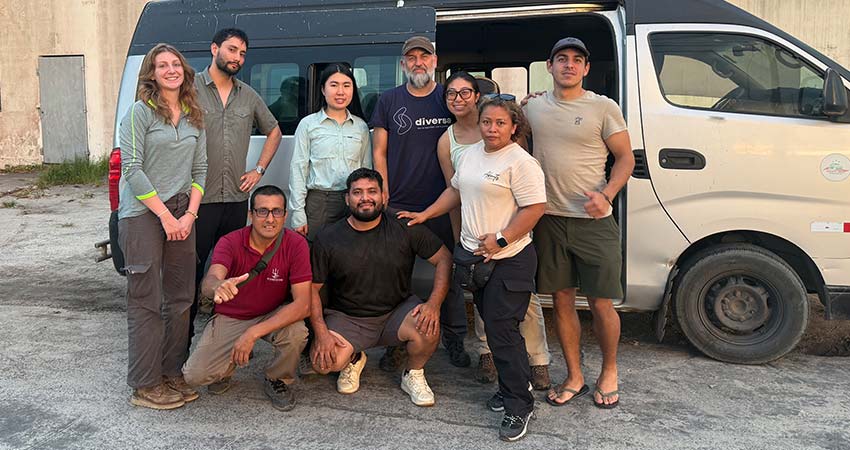
This summer, our student team from the MIT D-Lab classes D-Lab: Smallholder Agriculture and D-Lab: Design worked with the nonprofit Amanatari in the Peruvian Amazon, where we explored ways to support local production systems of aguaje. This included exploring potential uses for waste stemming from existing aguaje oil processes and identifying opportunities to improve the existing value chain for aguaje soap production.
Aguaje is a tropical palm fruit native to the Amazon rainforest, valued for its rich nutrient content, including vitamins, antioxidants, and phytoestrogens that may support hormonal balance during menopause. The Parinari community, located within the Peruvian Amazon, currently operates a local aguaje oil production business from the aguaje fruit. Currently, up to 70% of the aguaje fruit – consisting primarily of the seed and skin – is discarded in the oil-making process. One of our projects with Amantari aimed to brainstorm and test out potential uses for these waste byproducts.
Another community, Veinte de Enero, had previously mobilized their own aguaje oil production to also make aguaje soap. While the production plant has since fallen into disrepair, the community is eager to re-evaluate soapmaking as a business opportunity. A second team of D-Lab students worked with Amanatari in this community as well, aiming to understand the community’s soapmaking process, identify potential areas of the value chain to expand upon, and begin facilitating community discussion about the business.
Parinari: Charcoal
In D-Lab: Design, biochar seemed like a promising direction. With guidance from our instructors, Eliza Squibb and Ankita Singh, and building on previous D-Lab work from D-Lab Associate Director for Research Kendra Leith, we chose to explore turning aguaje waste into biochar. Its appeal was its versatility: biochar can be used as charcoal fuel, fertilizer, and potentially even in water filtration. Our decision was shaped by background research and early conversations with a member of Amantari and one of the Flores brothers, who run the aguaje oil press operation. We developed a protocol for making biochar from aguaje seeds and tested it on a small scale with avocado seeds before bringing it to Parinari.
Once in Parinari, we worked with Leo and Alejandro from Amanatari and longtime D-Lab colleague Alex Freese from Diversa (Colombia) to test the process with aguaje seeds and confirm that the protocol could work in practice. During our trip to Parinari, we introduced community members to a range of simple charcoal press designs that have been developed and successfully used in other parts of the world. We also conducted interviews with community members to better understand how biochar might fit with local needs and daily priorities. These conversations reshaped how we saw our project: we learned that local wood was already easy to get, government subsidies made gas tanks relatively accessible, and chlorine filtration tablets were being provided for free. Although charcoal may not be the right fit for this particular use, our trip allowed us to make valuable progress: a clearer understanding of community practices and needs, a tested method for turning aguaje waste into a product, and a starting point for future work.
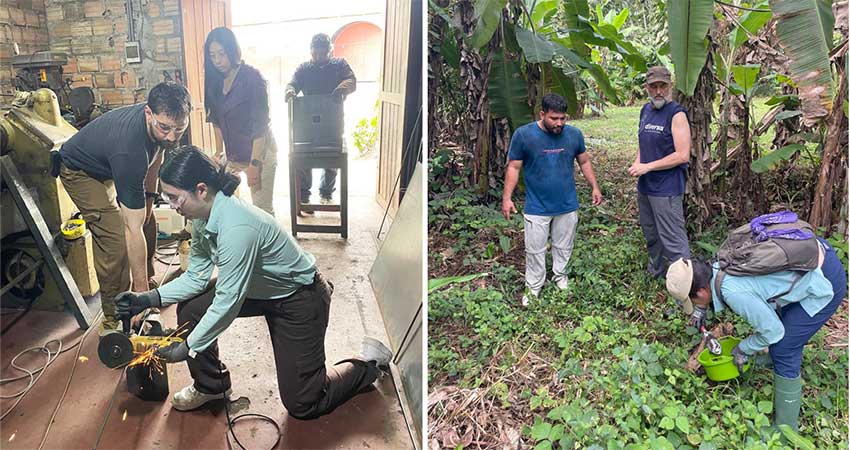
Jesús Coral (Amanatari), Alex Freese (Diversa) and Megan Hung (MIT) collect soil samples from a plantain field to gain a preliminary understanding of the soil nutrient profile in Parinari. Photos: Courtesy MIT D-Lab.
Parinari: Fertilizer
People often assume that the Amazon rainforest has strong soil health. However, during the D-Lab: Smallholder Agriculture class, students learned that the soil in the Amazon is quite nutrient-poor, as the high clay content of the underlying soil layers make nutrient absorption difficult and the nutrient-rich topsoil is subject to heavy rainfall. As a result, the team hypothesized that there might be community value in developing a fertilizer using local resources to enrich the soil.
The team conducted community interviews to understand current growing practices, both commercially and for personal use. At the same time, the team collected soil samples from various locations to establish a simple soil profile baseline, with a focus on testing the nitrogen, phosphorus, potassium, and pH levels at each location.
In parallel, the team assessed locally available agricultural byproducts to understand what could realistically be used as a fertilizer base. Community business owners, the Flores family, provided insight into some of the waste stemming from the local production efforts they oversaw.
The team decided to experiment with waste from three local fruits: aguaje, acai, and macambo. Having experimented with developing liquid fertilizer during the semester at MIT, the team used a similar process to create the three liquid fertilizers in Parinari. The nitrogen, phosphorus, potassium, and pH levels were measured for each of the fertilizers to assess their effectiveness.
Authors
- Megan Hung (MBA ‘26): Megan is an MBA candidate with a background in consulting and an interest in sustainability and start-ups.
- Haylea Brock (BS ‘27): Haylea is a class of ‘27 MIT undergraduate pursuing a degree in Environmental Engineering, with a vested interest in sustainable design and community-led agricultural initiatives.
- Kaylee Ji (BS ‘26): Kaylee is a class of ‘26 MIT undergraduate pursuing degrees in Computation and Cognition and Mathematics.
More information
MIT D-Lab classes: D-Lab: Smallholder Agriculture and D-Lab: Design
Contact
Kendra Leith, MIT D-Lab Associate Director for Research