

Our names are Alison Rufo, Chase Vanias, and Lio Mathurin, and we are MIT students studying Earth, Atmospheric, and Planetary Sciences, Computer Science, and Urban Planning. We traveled to Peru this past summer with Q’ochas Resilientes to explore the impacts of water scarcity in Pucachupa, an agropastoralist community living nearly 13,000 ft above sea level. Q’ochas Resilientes is a D-Lab-born organization addressing drought in the Andes through co-designing climate-resilient q’ochas, an ancestral technology that retains water from springs and rain. Q’ochas are over 3,000 years old and are specially adapted to the area’s unique hydrology. Our team’s mission is to work directly with the community of Pucachupa to design, implement, and monitor new q’ochas that are better suited for a changing climate.
This summer, we were accompanied by members of Q’ochas Resilientes from across the US and Peru. Our group traveled to Pucara in several stages throughout June and July, and some of us traveled to Temuco, Chile, to present at the Native American and Indigenous Studies Association (NAISA) Conference. We are grateful for the support of everyone else who came to work on this project: Rubí Cutipa Rojas, Shaela Sageth, Renzo Ramos, Helen Cardenas, and Lucia Diaz Garcia, and we especially thank Kathleen Julca and Stephanie Gavilan Chino for their leadership and Libby Hsu and Ursula Zuñiga for their mentorship.
Taking length measurements of Yanny’s spring-fed Q’ocha in Pucachupa
STAGE 1 (6/18/26 - 6/29/26): Understanding Q’ochas
During the first phase of the project, our team collected important measurements directly from nearby q’ochas. These measurements included perimeter, depth, and cross-body distance measurements. Additionally, we collected soil samples and did infiltration tests of the q’ocha soil bed and surrounding soil. These in-person measurements allowed us to create and calibrate a digital q’ocha water storage analysis tool that would enable us to simulate q’ocha drainage during the different seasons and better predict the water levels of any q’ocha. The hydrological team developed an HBV-light integrated model to analyze a q’ocha given specific infiltration measurements, and also began to model future-planned q’ochas in the area.
A spring-fed q’ocha in the community of Pucachupa.
STAGE 2 (7/5/26-7/21/26): Working with Community
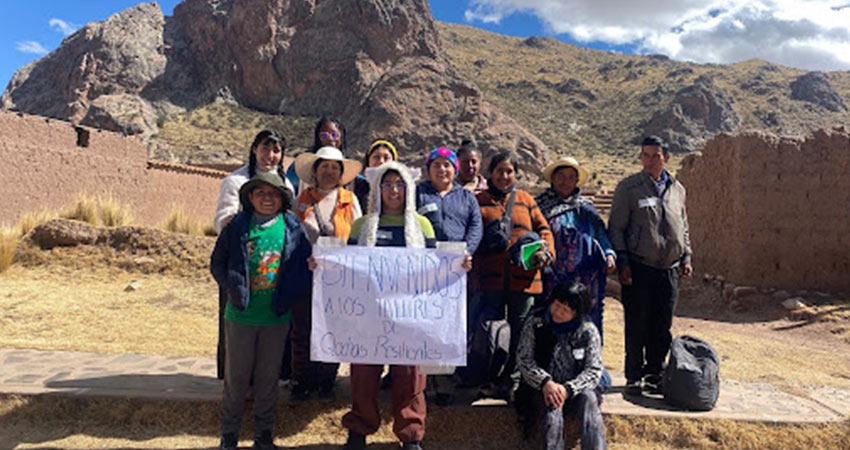
While modeling and measurements were still taking place, the July portion of our site visit was focused on community engagement. Inviting residents of Pucachupa and the surrounding area to our working sessions and creating space for feedback and genuine involvement is pivotal to our organization’s model. To further establish our mechanisms for this collaboration, Q’ochas Resilientes held community workshops throughout the first half of the month dedicated to reflection and artistic expression surrounding water and biodiversity issues in the area. These workshops produced pottery, woven, and painted artifacts that were later displayed in the local cultural museum. On the exhibition’s opening day, community members came together to share music, food, and stories about water and tradition.
A pair of toritos (bulls) painted during a community workshop. The colors depict different aspects of the local landscape: green represents nature, light blue represents the sky, and dark blue represents water. Artists: Gregorio Choque y Carmen Huaman Alvarez.
STAGE 3 (7/26/26 - 8/5/26): Planning our Next Steps
The last leg of our trip to Peru this summer was dedicated to wrapping up measurements and collecting the final data that we need to complete our simulations and decide where will be best to construct our pilot q’ocha. Over the next semester, we will be working with D-Lab, UTEC, the University of Hawaii, and virtually with the community to decide how and where to build the first climate-adapted q’ocha in Pucachupa. Location, material, dimensions, and hydrological fit will all be very important factors to consider during our planning, as well as who will be responsible for maintaining and monitoring the q’ocha after it is completed. In addition to the localized benefits to Pucachupa and its surrounding watershed that come with higher surface retention of spring water, we are hopeful that Q’ochas Resilientes’ co-design model for restoring indigenous climate technologies will provide a useful framework for similar projects around the world.
Evening fieldwork in Pucachupa- team members measure and evaluate a local q’ocha.
Thank you so much to MISTI, D-Lab, UTEC, the PKG Center, and the MIT Climate Project for making this trip possible. Most of all, thank you to the people of Pucachupa and Pucara for teaching us so much and welcoming us into their communities. Water is life, and campesino livelihoods do not deserve to take the brunt of the damage from a climate crisis that they had no role in creating. We are fortunate to have had the opportunity to work with so many amazing people on this project, and we look forward to continuing to support Q’ochas Resilientes in their mission to support safe and reliable water access in the Andes.
Members of Q’ochas Resilientes holding a poster alongside several attendees of our community co-design workshops in Pucará (text translation: welcome to the Q’ochas Resilientes workshops).