

Preparation, the team, the community partners
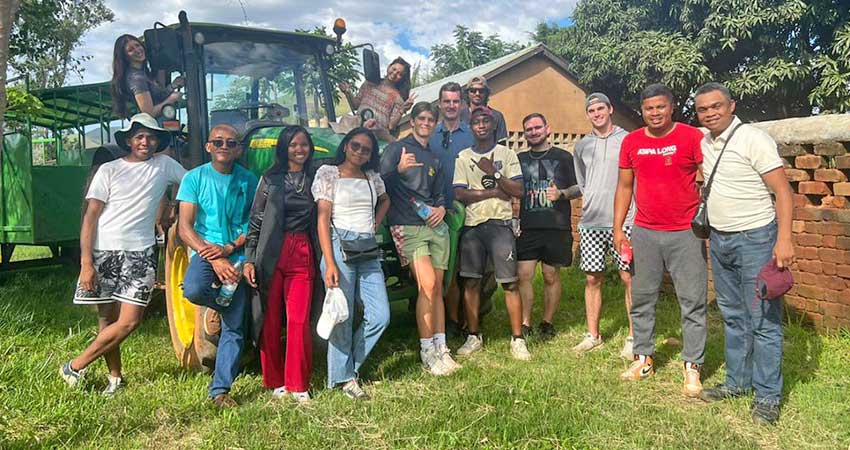
From January 5 to 25, our team traveled to Madagascar as part of the MIT D-Lab: Development course. We arrived following a semester of research, project preparation, and a set of prototype designs developed in collaboration with our partners in Madagascar. These prototype designs focused on helping farmers preserve soil moisture in one of the driest regions of Madagascar. Our experience and the shared knowledge of local stakeholders changed both these initial prototype designs and our understanding of the challenging realities of sustainable development work.
Our interdisciplinary group included Lars Spinetta (MIT undergraduate, Math), Elwin Furtrell (MIT undergrad, Math), Darya (MIT graduate student, Building Technology), Warren Knowles (MIT undergrad, Design and Urban Planning), Varun Maniar (MIT graduate student, Architecture), and Alyssa Papantonakis (MIT graduate student, City Planning).
We were led by Dr. Karl Zimmerman, a water engineer based in Canada. In Madagascar, we worked closely with Manampy Randriantenaina and Tafita Voarintsoa (graduate students at ESPA – Ecole Supérieure Polytechnique d'Antananarivo, basically Madagascar’s MIT), and Jessie Andriamanankasina from Tatirano. Their knowledge of local material constraints, agricultural practices, and language shaped every decision we made. Our group was aided and led at different points by Harry Chaplin, founder and CEO of Tatirano, and Dr. Angelos Andriamanampisoa, an ESPA professor and the Vice President of Tatirano’s Board of Directors
Why water matters in Androy
Androy is defined by water scarcity. For most of the year, rainfall is infrequent and unpredictable, leaving communities dependent on wells or purchased water. Buying fresh water is expensive and places significant strain on household finances. Many families rely on shallow wells, but the water is often saline and poorly suited for farming. As a result, crop options are limited, yields are reduced, and nutrition, food security, and financial stability are all affected. In this context, even small improvements in preserving fresh water can have a meaningful impact.
To put into context the effect Tatirano has had on villages in rural southern Madagascar, a liter of water in a small village we visited in the rural Androy region cost about 2000 Ariary (about fifty cents) before Tatirano built a water delivery system. The kiosk operator told us that they typically charge less than 500 Ariary for a liter of water now, cutting the cost by about a quarter. This is one of the more expensive places to buy water from Tatirano, since a truck has to traverse a treacherous road in order to deliver water to this village. The cost of the water covers the cost of purification, chlorination, and gas for delivery.
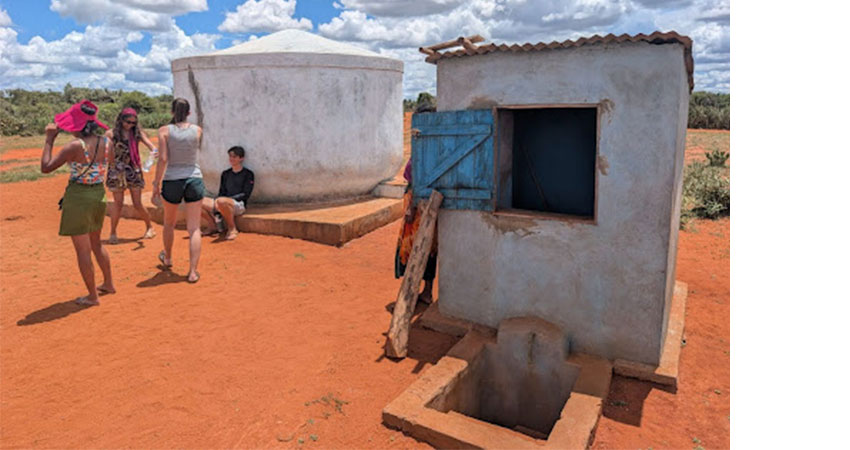
In the D-Lab: Development course, we did not specifically study farming systems (though if you are interested in this, check out D-Lab: Agriculture, EC.724/EC.784). Much of what we learned about agriculture was learned through our team’s independent research and from farmers on the ground in Madagascar. During the class, we examined water access broadly in the global south, including the health implications of limited clean drinking water and the disproportionate burden placed on women and children to collect it. We learned that transporting water is time consuming and physically intensive, often requiring hours of walking each day, and the effects of water scarcity are catastrophic. Our field school showed us that what we learned in class was a reality – water is not only a technical resource to manage, but a daily labor that shaped how people spent their time and energy.
Scarcity as a design constraint
Our visit to Tatirano, a local organization that builds and maintains rainwater collection systems in the South of Madagascar, highlighted the importance of designing within a context. Their systems work because they are materially pragmatic and every component reflects what can realistically be sourced, transported, repaired, and afforded in the region.
The prototypes designed before the field school relied on materials like plexiglass, sheet metal, and lumber. In southern Madagascar, plexiglass is expensive and hard to find, metals are costly unless recycled, and standardized wood is rare. Since typical materials we designed with were inappropriate for the context of this project, we returned to the drawing board with our local partners.
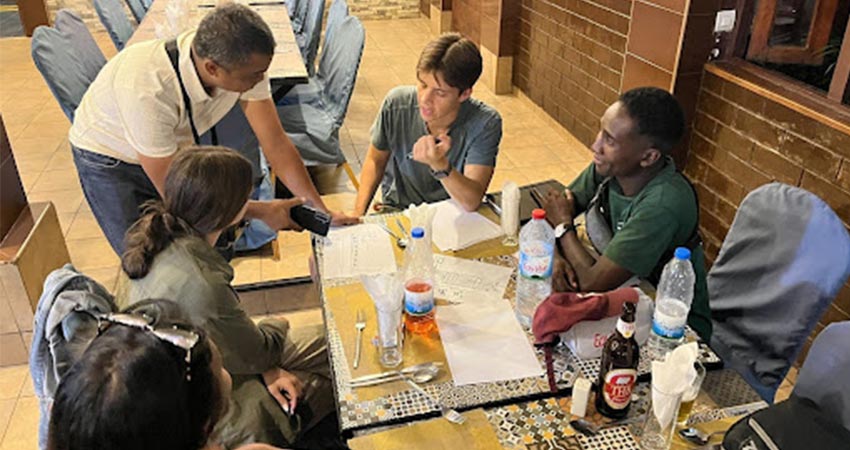
Designing with the community meant that our ESPA and Tatirano partners were co-designers, and their crafting knowledge, technical expertise, and camaraderie were essential to the process of redesigning our closed-loop agriculture system. This process required us to rework ideas that were theoretically and scientifically good, but did not align with local realities, and to accept trade-offs between efficiency, cost, and utility.
We purchased what we could in Fort Dauphin, constructed as much of the prototype as possible, and then transported everything to Ambovombe for installation. The systems were erected on a farm owned by Taza Remanjafy, a local scientist, industrialist, and farmer who has been running an experimental farm in Ambovombe for the past decade. Because we could not rely on finding additional tools or materials once we arrived, we had to ensure that everything was purchased, packed, and loaded onto the vehicles before the three-hour drive to Ambovombe.
Prototypes
Stand Pipe prototype
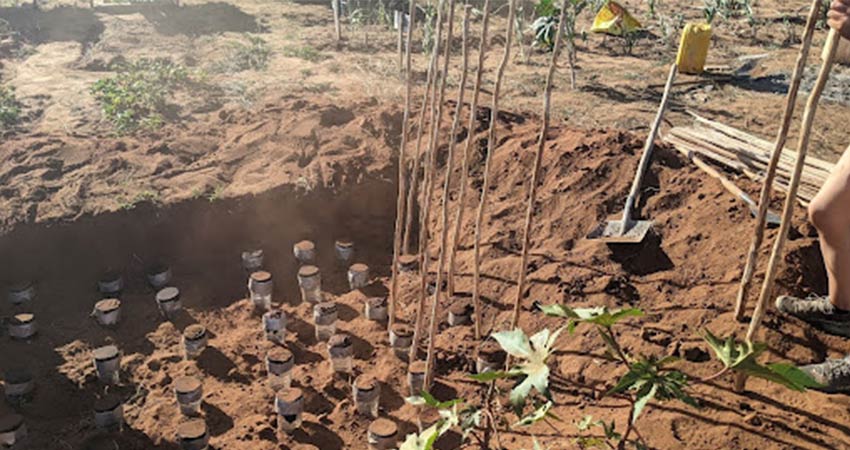
The first design, spearheaded by Taza, used recycled plastic bottles buried beneath the soil surface. Each bottle was cut open, filled with fresh water, and capped with a layer of cotton fabric. A hole approximately 50 centimeters deep was lined with an array of these bottles and then back-filled with soil. The idea is that water held within the bottles will gradually evaporate, pass through the cotton layer, and slowly moisten the surrounding soil while minimizing surface evaporation. Over time, the goal is to test whether the fresh water in the bottles can be replaced with more readily available brackish water.
Drip Irrigation
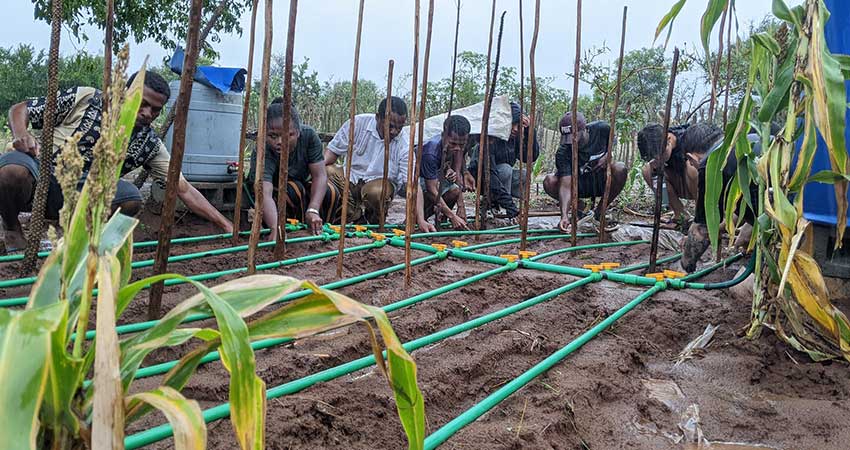
Our second prototype was a simple drip irrigation system. Although drip irrigation is widely used in other parts of Madagascar, it has not been broadly adopted in the south, and we wanted to test whether it could significantly reduce water use in this context. Two different tanks provide different qualities of water (salty vs. sweet), which allows the farmers to test how much different water quality affects the growth of crops and their yield. Before laying the pipes, the plot was excavated and lined with a plastic tarp to limit water loss through deep percolation. The system operates manually, with the farmer periodically opening and closing valves to water the crops.
Greenhouse
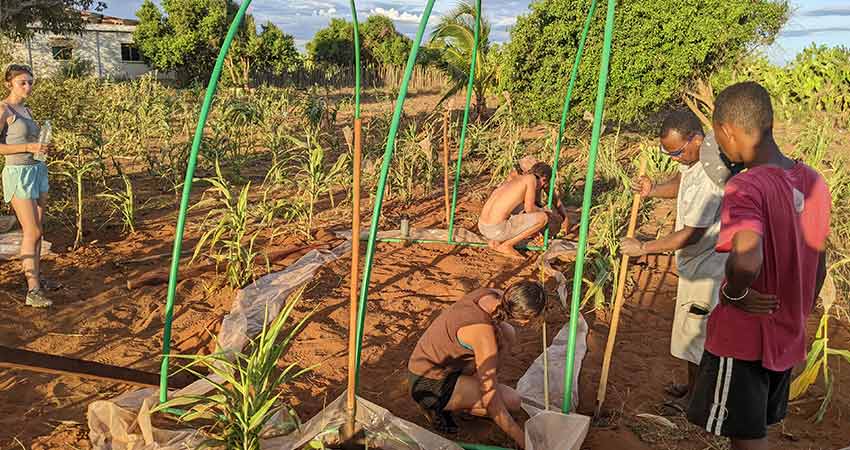
Our final design involved constructing a PVC enclosure lined with plastic tarp that sits over the test bed. The intent was to create a semi closed system in which evaporated water would condense on the interior surface of the plastic and drip back onto the soil. The plot itself was also excavated and lined with tarp to further limit water loss into the ground. While the system is largely passive, it is not entirely sealed. Some moisture escapes through small gaps in the seams and through plant uptake, so the farmer periodically enters the enclosure to water the crops when the soil becomes too dry.
Looking forward
The combination of classroom rigor and immersive fieldwork reshaped how we think about engineering and design. Entering the Malagasy system, and designing around culturally appropriate technologies and crops rather than operating apart from it, allowed us to refine the project in ways that feel more likely to endure.
On our last day in Ambovombe we worked with students from a local university who would be in charge of periodically checking on the three test plots and collecting data on the plant growth, water usage and resiliency of the prototypes. We explained how each prototype worked and went over the data collection tables that they would be using to document the experiments.
Future D-Lab teams traveling to Madagascar can iteratively build on these projects, consolidating successful elements into a more unified system that can be shared more broadly across the region. What we hope endures is not only a set of techniques, but a commitment to designing with communities, grounded in humility, respect, and attention to the context of this unique region.
More information
MIT D-Lab class D-Lab: Development
Contact
Libby Hsu, MIT D-Lab Associate Director of Academics