

Purpose, product, and partners
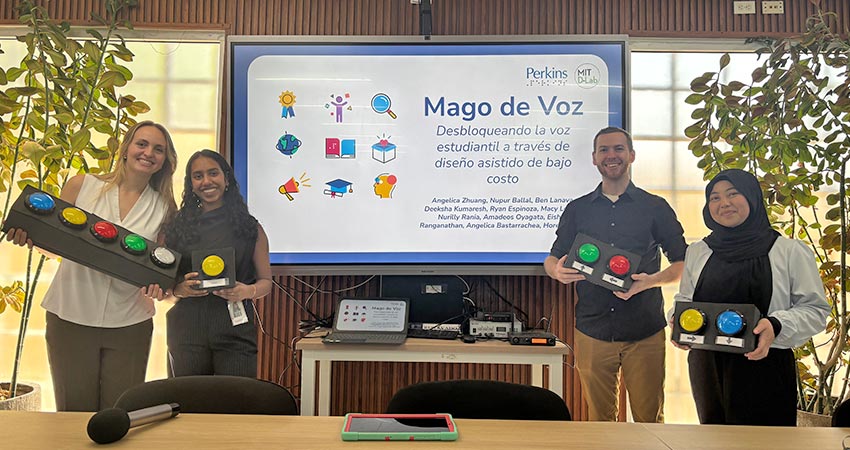
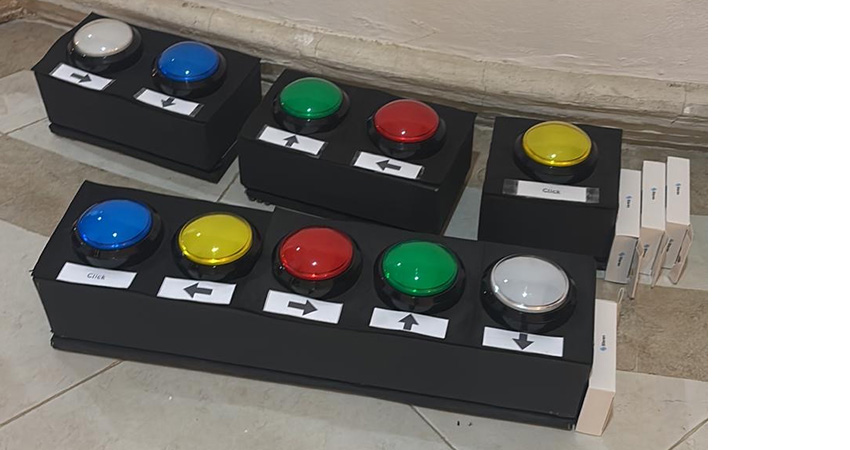
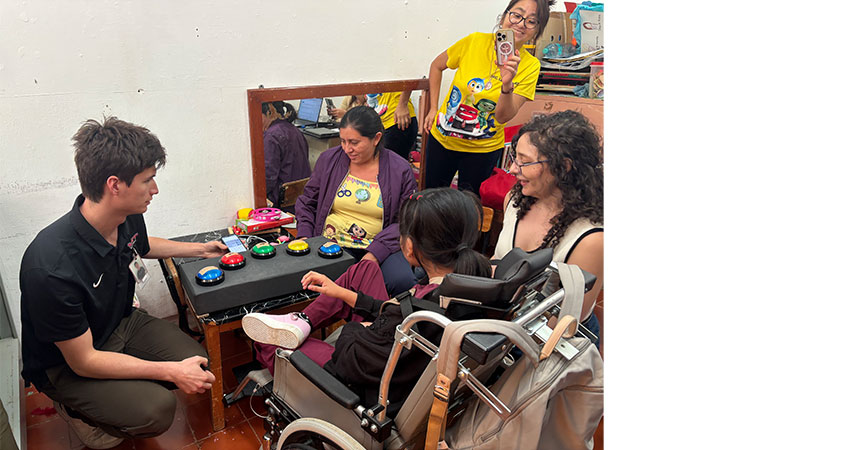
For the first three weeks of January, our team from the D-Lab: Development class team traveled to Mérida, Yucatán, in collaboration with our partner, Perkins International. There, we built, field-tested, and integrated our augmentative and alternative communication device, the Wizard of Voz (WOV) Keyboard: an assistive, five-button Bluetooth device (which can be split into multiple modules for greater flexibility) designed to help students with multiple disabilities more easily communicate using a tablet or computer. Instead of requiring fine motor taps on a touchscreen, which can be especially difficult for students with motor disabilities, it provides large button inputs for Up/Down/Left/Right/Click so users can navigate communication software more comfortably and reliably, encouraging communication and independence. Our overarching goal is to support more independent communication from students by making it easier, more consistent, and less physically demanding to communicate their desires.
The device includes custom features catered to the needs of the students, including child-safe paint, non-slip bottoms, velcro-attached, easily cleanable foam on top, and buttons that can optionally light up when pressed. It was designed so that the builder can decide how many buttons go in each module, or individual box, meaning the buttons can be moved to different places on the body if that better enables students to use it. The design process exhibited co-creation with community members as we constantly incorporated input from teachers and students studying rehabilitation at a nearby university, Universidad Autónoma de Yucatán (UADY).
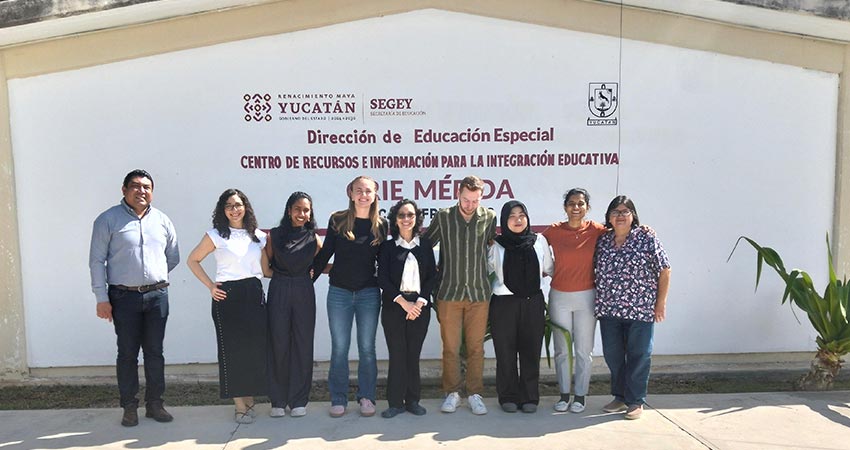
In addition to Perkins, we also worked alongside the Proyecto Pixán initiative (established by Perkins & Secretaría de Educación del Gobierno del Estado de Yucatán), the illustrious student body of UADY, and the incredible teachers, administrators, and students of Centros de Atención Múltiple (CAM) #1 and #6, special education public schools in Yucatán and Campeche.
What We Anticipated
Before arriving, we had a device with all of the buttons arranged in a cross, plugged into a computer via a USB cable, and little to no preparation for how we were going to encase the device or adapt our design. What we were missing was that the true value of a device like this was the fact that each teacher could customize it to individual students depending on their bodies’ principal movements.
Learning from school visits: CAM 1 & 6
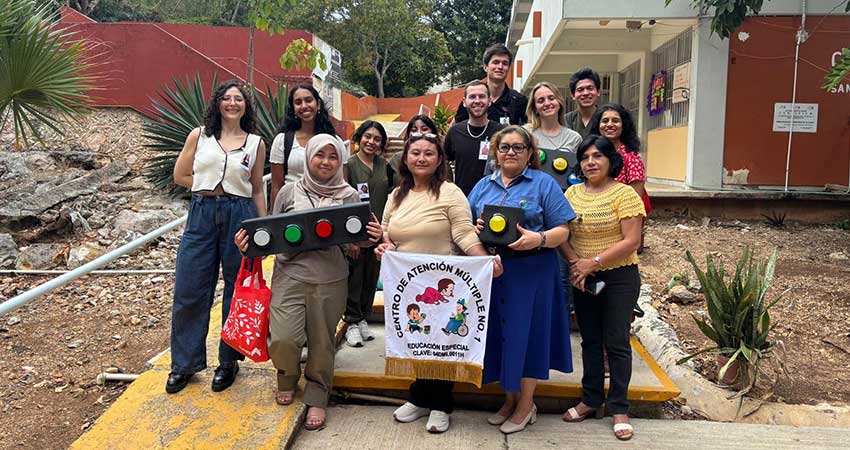
Our first real lesson came from our school visits to CAM 1 and CAM 6. We met incredibly welcoming teachers and students who were willing to sit with us as we watched students attempt to use our device, and who gave feedback that directly changed the direction of our work. Early on, our most fatal error was not adapting our communication software to Spanish before the visit. It was here we learned the significance of the non-technical aspects of our device. Though we had spent a lot of time with the coding and Bluetooth connection, we had overlooked the importance of the language.
At that point, we had a five-button device with the buttons arranged in an arc. This made the central button quite difficult to access as it was farther away from the user, and we realized it was hard to tilt the device because it was so tall and wide. Our most crucial corrections, we discovered, were not to the circuitry as expected but instead to the casing and to the communication software we were choosing. With guidance from teachers, students, and Angie, we moved forward with AsTeRICs Grid as our software and made the decision to scale down our device as much as physically possible.
The students from UADY joined us on these visits, and their expertise in accessibility adaptations inspired us to add non-slip to the bottom of the devices, as well as a cheap, Velcro-attached piece of foam to the top of each device for easy cleaning and customization. Across both schools, we also learned something even bigger than any individual design tweak: students with a wide range of verbal and motor disabilities can benefit from the same core device, from students who use wheelchairs to others who are nonverbal. Seeing the WOV Keyboard used in different contexts helped us isolate what features were universally desired and which ones were specific to individual students, so that if the device is recreated, it can be altered to contain any number of personalized features.
We were a truly lucky team to have so many different parties wanting to help us improve our device, and these visits taught us the value of many different perspectives influencing our work.
How D-Lab values guided us
This trip reinforced MIT D-Lab approach and values across the board, but especially co-creation, co-design, affordability, and reproducibility. Co-design was a priority coming in, as we as a group openly discussed ways to make the teachers and UADY students feel more comfortable and share their ideas. The input we got from people native to the area and the schools made our product infinitely more successful. Co-creation, with a focus on affordability and reproducibility, became significant towards the end of the project when we realized that the device could be significantly more impactful if the teachers were able to customize them to each student, and if the teachers gained the confidence to build devices themselves to help their students. Although we weren’t able to teach every single teacher in the span of three weeks, we were able to teach Angie the entire construction, wiring, and code process from start to finish. Additionally, we had the absolute privilege of giving an in-depth presentation on how our device works and how someone can learn to recreate it. Not only did some UADY students approach us after the fact to follow up on constructing one themselves, the representatives we met from the Secretaría de Educación del Gobierno del Estado de Yucatán were equally excited about our project and to promote its continuation in the region.
Our closing reflections
We left Mérida with a stronger sense of the difference between building for someone versus building with someone. As the project went on, our determination to build something lasting and truly helpful grew stronger, and our community partners matched our excitement and then some. Each one of us was touched and inspired by the undying commitment of our partners to working to help other people, and we know for a fact that this project would not be possible without every person who went above and beyond to help us.
On the whole, assistive technology isn’t just about someone being able to say “Yes,” “No,” or “I want,” but rather about giving someone the ability to make an independent choice about when they speak and what they say. As we said often as we built on late nights, our devices were made with love, both from us and from everyone who touched our experience in Mérida.
Acknowledgments
We are all deeply grateful to Perkins School for the Blind for their partnership, sharing their expertise, being so committed to disability access, and especially for making this work possible. An extra special thank you to one of Perkins’ Education Coordinators, Angelica Amatista Bastarrachea Fajardo, or “Angie,” for her unending commitment to the project and to supporting our team. She has touched all of our lives and greatly inspired our work. None of this would have been possible without her love and work.
We also extend our sincere thanks to the Secretaría de Educación del Gobierno del Estado de Yucatán for welcoming us and supporting this work. Thank you as well to the Universidad Autónoma de Yucatán (UADY) students that spent many an afternoon helping us: Horeb Cauich García, Ian Collí Spalding, Rubí Cab Huchin, Mía Collí Rosado, and María José Herrera Noh.
Finally, thank you to MIT D-Lab for the mentorship, resources, and design framework guided our approach and allowed us to have this experience.
About us
Our group was composed of eight students and our trip leader, Eishna Ranganathan. We have five MIT undergraduates: Deeksha Kumaresh, a bioengineer in her junior year, Ryan Espinoza, a mechanical engineer in his junior year, Macy Lehrer, a computer scientist in her junior year, Nupur Ballal, a biologist in her junior year, and Angelica Zhuang, an architect in her senior year. We also have three Harvard graduate students: Ben Lanava, a Ph.D. Candidate in Population Health Sciences studying at Harvard T.H. Chan School of Public Health, Nurilly Rania binti Jusly, a teacher studying at the Harvard Graduate School of Education, and Amadeos Oyagata Maigua, a Master in Urban Planning Candidate at the Harvard Graduate School of Design. Our trip leader, Eishna Ranganathan is an alumna of MIT Sloan’s School of Management and currently works as a People Analytics Analyst at Visa.
More information
MIT D-Lab class: D-Lab: Development
Contact
Libby Hsu, MIT D-Lab Associate Director of Academics