

The Prelude: Humanitarian Innovation
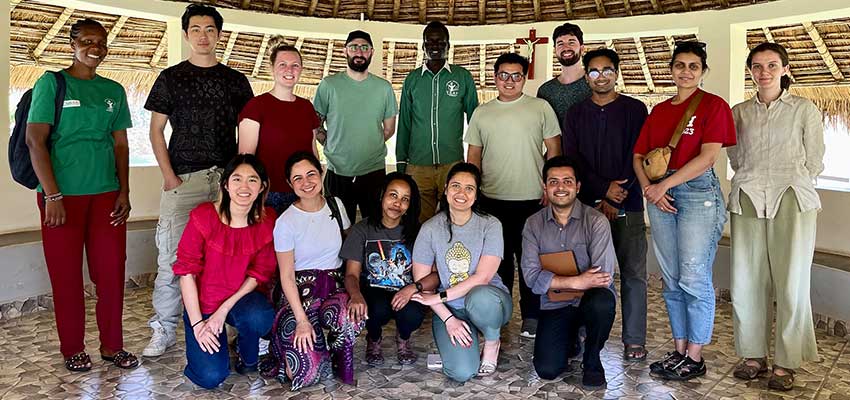
In the eye of the storm - amidst an unprecedented gutting of humanitarian aid sources, including USAID; upheaval across academia; and ongoing humanitarian disasters and suffering - this was a historic moment to be studying humanitarian innovation. Our Humanitarian Innovation class of 12 at MIT D-Lab, ranging from engineers to consultants, political scientists, advocates, architects, and more, approached the material with a broad spectrum of perspectives. We committed to understanding humanitarianism, its evolution, the role of innovation, and the power of co-creation. I came ready to explore this intersection - leveraging engineering and innovation more broadly for tangible impact.
The months leading up to this were comprised of teachings on humanitarianism, challenges and failures, participatory models, the co-design process, the design process, and much more. We read extensively on global health, pressing cases, the humanitarian timeline, all diving deep to understand what we were seeking to impact. Designing a refugee camp, we all failed spectacularly. There is so much to learn. Got to know each other, unearth biases. But we were still caught up in the hustle and bustle of Boston and our personal lives. The true experiment, of which we were the subjects, had yet to begin.
Our class became stronger with each setback. You see, a van breaking down might mean we are stranded for a couple of hours. But more importantly, it was a chance to build trust with our classmates. Step up and help each other unload and reload our van twice. Offer up water and snacks. Pose for silly pictures with goats and take turns napping.
Uganda 2025 Co-Creation Summit reflection
Hosted in the West Nile region of Uganda, the 2025 Co-Creation Summit was a unique opportunity to engage meaningfully in hands-on problem-solving. The summit focused on developing technical solutions to address stakeholder-identified challenges in the Rhino and Imveppi refugee resettlements. Facilitated by D-Lab staff, we collaborated with NGOs, local refugees, and other MIT students. By engaging refugees and displaced people in the design process, we would ideally be building in a sustainable manner. This was an enriching experience to learn from, connect with, and build for people of very different circumstances. In this reflection, I will highlight some key moments I recall from working with our team, how I would improve this experience, and a key learning I will take forward.
Key moments: downtime & field experience
One general set of experiences that stands out wasn’t necessarily a formal meeting or brainstorming session. Rather, while working with my team, the moments that particularly stood out are our moments of downtime. Yes, our moments of collaboration were fruitful - we ideated, researched, and designed together. We went from a timid group of eight people, unsure of how we would fit together, to launching an idea we are all excited to develop. During our collaborative moments, we ascertained trust. But it is during those moments when we finished early, and could speak in an unstructured manner, that we most connected. When we discussed current events, family, and faith, we were most vulnerable. It is during these moments that we developed a mutual understanding of our common ground - organically. This is when we fostered camaraderie, enabling us to work more effectively as a team during formal sessions.
Moreover, visiting Rhino settlement emphasized the why of it all. Seeing how these systems work in real life, the application side of things intrigued me. This is why I became an engineer. This was no longer a theoretical, academic assignment. The beauty of real life is the dimensionality. Our first day of field experience and stakeholder interviews was multidimensional. I sincerely appreciated it all. I particularly remember having no idea what to expect as we drove on uneven, red roads for hours leading into the camp. I braced myself. As we pulled up to the camp, I stumbled out of the car and was ushered into a meeting with the deputy director of the Office of the Prime Minister. One of the few selected for this first task, I felt wholly unqualified. Who am I to ask permission on behalf of us all? The meeting was formal with many niceties, something I have only seen in Eastern parts of the world. It went well, we were approved for our projects, much due to the groundwork our teammate had already done. Next, we had an impromptu meeting with the director of health in the camp. Too timid to ask my questions during the meeting, but realizing I might never get my chance as we began to leave, I doubled back to ask those lingering questions. A question that is tied directly to my current fellowship.
Our first meeting was with the local Village Health Team. We pulled up chairs and benches by one of the clinics, under a large tree. VHTs are volunteers, many of whom have medical backgrounds, but their credentials didn't cross over. A committed group of about 30 people met with us. The meeting began slowly; people seemed exhausted and shy. But surely, as with any group, the questions slowly broke the ice, and soon enough, we had a conversation. Frustrations were shared about projects that start and never go anywhere, the resources that kept getting cut, constant turnover within the population - the difficulties inextricably exacerbating healthcare delivery failures. I couldn’t help but get a sense of overwhelm. These were the frontline healthcare workers; they were at their limits. Where do we even begin?
My group members led the charge during our meetings with the volunteer health workers, and I was appointed to lead the IRC meeting. This experience was a collaborative one. We prepared for it extensively. It made a difference of night and day for my ability to understand the system at hand.
Key learnings: the power of listening and relationship building
One key learning I will take forward from this experience is the profound importance of listening in collaborative settings, particularly to not making assumptions. Going into this experience, I anticipated my assets would be my empathy, engineering skill set, ethnic background, and broad range of cultural exposure. My priority was to learn. To learn from the setting, the people, the infrastructure, the systems. My goal was to listen more than I spoke. Honestly, my favorite thing to do in our group was sit back and see who would speak. I did not want to be the person imposing her ideas upon others, nor did I want any leadership position, which I typically fall into organically.
We could all benefit from listening more than we speak.
Conclusion
The Co-Creation Summit, and this class moreover, was truly an experience that has fundamentally shifted my approach to engineering for humanity. Prior to this experience, I was uncertain of how to combine these two equally important career objectives. However, co-creation summits are testaments to the fact that this can be done effectively. Whether through a memorable conversation during our downtime, the importance of a token of appreciation, or reaffirming the importance of listening-more-than-one-speaks, these lessons will stay with me as I continue to pursue community-driven technical innovations and bourgeon into this career.
About the author
Husna Ellis is a bioengineer and researcher from the Langer Lab and Traverso Lab for Translational Engineering at MIT. Committed to transforming healthcare.
Related
Building community in Uganda: a Co-Creation Summit experience
Co-Creation is a circle, not a line: lessons in listening, building, and belonging in Uganda
Finding inspiration from co-creating in Arua, Uganda
More information
MIT D-Lab Humanitarian Innovation class