

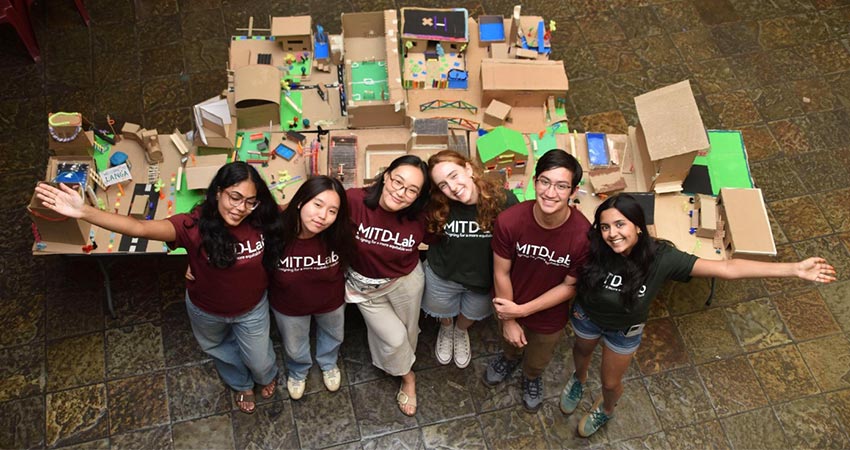
This January, as part of the D-Lab: Development class, we ran a Creative Capacity Building workshop in Langa, Cape Town, South Africa. Langa is the country’s oldest township, established in 1927 under apartheid-era segregation policies. In partnership with Mzikhona Mgedle, founder and managing director of the Langa Bicycle Hub, we designed and facilitated a participatory, youth-centered co-design program aimed at building agency, practical skills, and creative problem-solving capacity within the community.
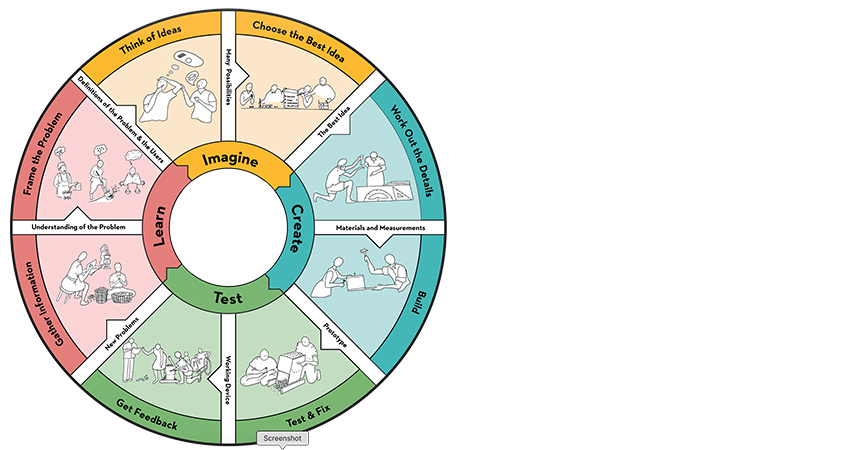
Over the Fall 2025 semester, our team, led by Michela Galazzi and Maddie Johnson-Harwitz, engaged in extensive background research and held recurring conversations with Mgedle and other local stakeholders to understand Langa’s social, economic, and health-related challenges. Guided by these insights, we oriented our program toward youth who were no longer in school, recognizing the structural barriers faced by young people who do not complete the Grade 12 matric in South Africa and are consequently excluded from many employment and service pathways. The workshop curriculum was structured around MIT D-Lab’s design process wheel, with each day dedicated to a different phase of the cycle (learning, imagining, creating, and testing) through hands-on challenges, reflective exercises, and collaborative prototyping.
Engaging the community to better understand Langa
The most important aspect of our trip was engaging directly with communities in Langa to better understand both the challenges they face and the opportunities they see, grounded in their lived experiences and perspectives. Our team prioritized meaningful, in-depth conversations as respectful outsiders, approaching topics such as urban infrastructure, health, and education by creating a space that felt not only safe but also welcoming and engaging. On our second day, we facilitated three participatory activities with 30 community representatives: a dialogue walk, a calendar exercise, and semi-structured focus group discussions.
During the dialogue walk, small groups guided by our team members explored neighborhoods in both Langa township and the informal settlement of Joe Slovo. This walk offered firsthand insight into housing and infrastructure concerns, including fire risks associated with building materials and informal electricity connections. At the same time, it highlighted the strong social fabric of the area, revealing how neighbors support one another and demonstrating the community’s resilience.
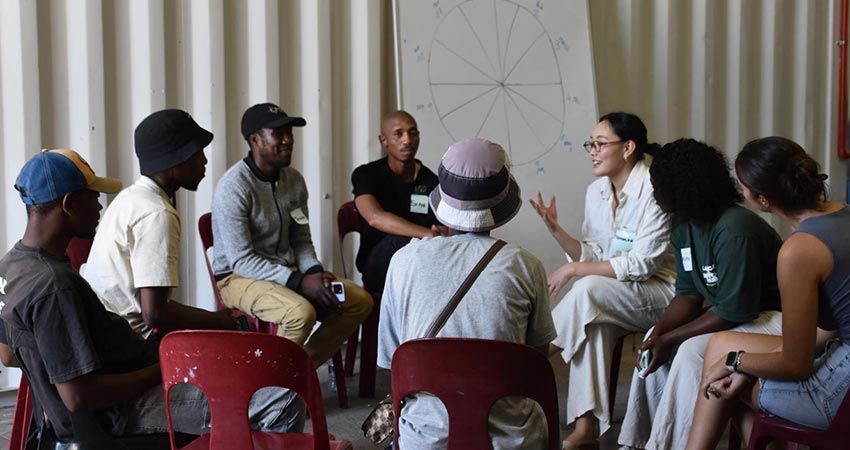
In parallel, we facilitated the calendar activity to map livelihood patterns, local events, cultural practices, and seasonality within the township. Participants reflected on how their routines shift month by month, the difficulties of securing employment during high-demand periods, and the ways climate variability is disrupting traditional seasonal expectations. The discussion also underscored a deep sense of cultural identity, with participants describing how national and local celebrations help sustain shared heritage across the year.
Based on the findings from these activities and the focus group discussions, we learned that Langa is a community marked by both structural challenges and strong social cohesion, where residents continuously adapt to economic and environmental pressures while drawing strength from strong networks of mutual support and cultural pride. These findings also informed how we designed our activities for the following weeks, including organizing fire hazard training sessions and ensuring they were accessible not only in the township center but also within the informal settlement.
Facilitating the Youth Co-Design Workshop
Though the team had spent the better part of the semester meticulously creating a lesson plan for the co-design workshop, we quickly realized on Day 1 of the workshop that we needed to pivot. Instead of 16- to 19-year-olds, we received much younger participants – mostly 10- to 14-year-olds, with a few older teenagers. The lesson plan was revised to include more hands-on activities that would be engaging for kids. Our young participants were divided into teams, each of which would use the design cycle to build their own future “mini-Langa” out of sketch-modelling materials like cardboard and clay.
Our workshop participants, despite their youth, had an acute understanding of the problems, needs, and wants of their community. On Day 2, which was themed around the “Learn” phase of the design cycle, participants created problem wheels listing the causes and effects of challenges in their community. They identified issues like unemployment, flooding, homelessness, and lack of third spaces. They then spent Days 3-5 prototyping their “mini Langa” and implementing their brainstormed solutions to these issues. For example, participants built more housing to remedy homelessness, computer and science centers to support those facing unemployment, and libraries and pools in response to the lack of third spaces.
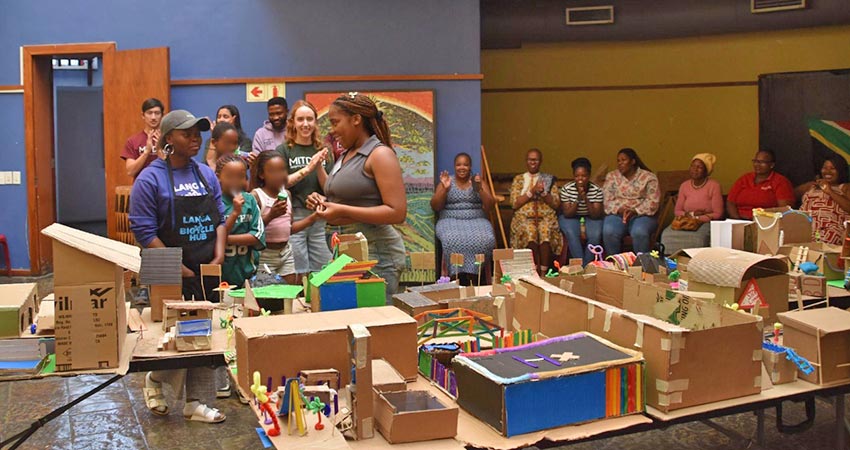
On Day 6, the teams assembled their contributions into a collective mini-Langa, and parents and community partners were invited to watch participants present their prototypes. Given the tools and training, participants were able to ideate solutions and create prototypes that addressed their problem wheels. We were moved by how bright our kids were, and their love and hopes for the community, which really shone through in their wonderful creations.
Training-of-Trainers Workshop
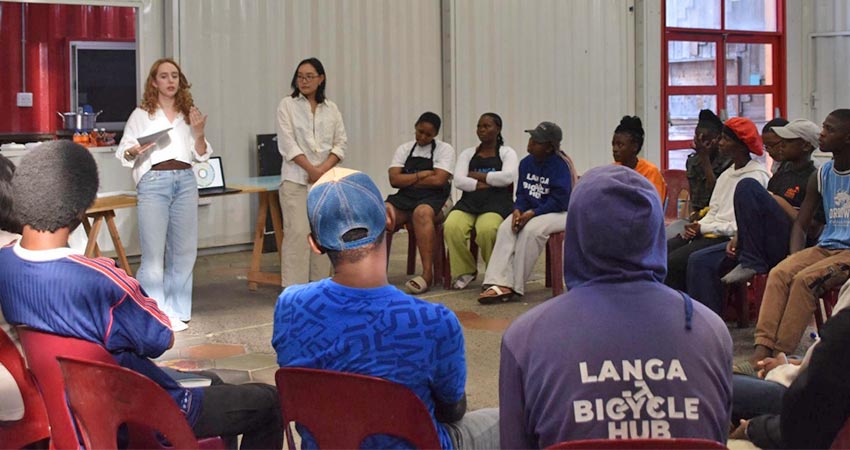
The Training-of-Trainers workshop was less about introducing something new and more about making space for what was already happening. We gathered with community leaders who were already engaged in ongoing projects with Langa youth and revisited the co-design process we had used in the previous week to unpack it from a facilitator’s perspective.
The team created and shared two key documents. The first was a day-by-day guideline of the youth co-design workshop, detailing each activity, its purpose, and where it fits within the Design Cycle. The second was a facilitator’s guide, outlining the different phases of the process and presenting tools and activities that can be adapted at each stage. These materials helped ground conversations about problem framing, power, creativity, and feedback as dynamics that already emerge in their own practices.
The space became one of mutual exchange. By the end of the workshop, participants had created a shared community and WhatsApp group to continue sharing experiences, ideas and questions. The goal was continuity, to support the local initiatives with tools that could help the projects grow after we left.
Healthcare Workshops
Through a previous D-Lab student project originally begun in 2023, that eventually resulted in the founding of REACH by our trip leaders Maddie and Michela, it was learned that emergency response officials often refused to enter Langa. On healthcare provider maps, Langa is labeled as a red zone: an area that one should only enter with extreme caution. While the REACH team works to combat this issue by designing a stretcher to reach patients, thousands of Langa residents still suffer from the lack of knowledge around first aid and an immediate solution.
The idea of the healthcare workshops was to provide education on how to tackle emergent and common health concerns in the community. After refining the curriculum by talking to our partners at local governmental and community outreach groups (Portia Nontembiso Makwetu and Yvette Andrews), Saachi refined our curriculum to CPR, managing major bleeds, motor vehicle accidents, choking, burns, and fire safety. Saachi, an EMT-B with MIT’s student-run ambulance, tailored and led the workshops. We conducted a total of three workshops over the course of our third week in Langa: one in the community cultural center, and two in Joe Slovo, a community we’ve never had the opportunity to work this closely with before, teaching a total of 55 community members and leaders.
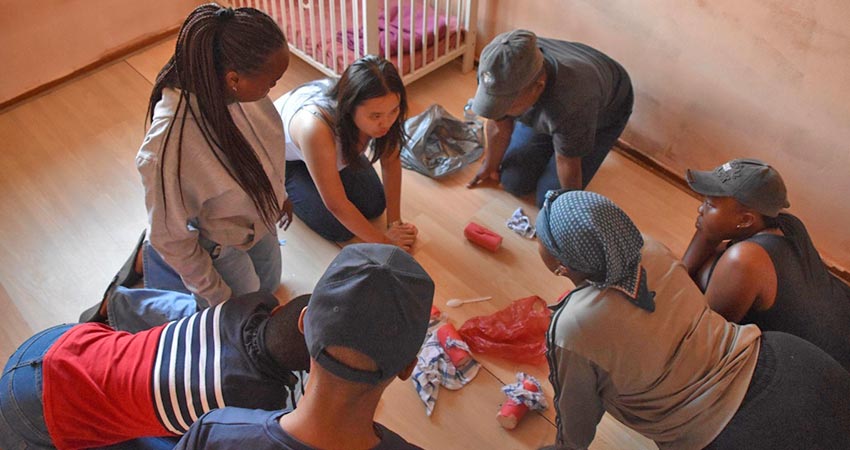
Saachi also identified a lack of conversation about and support resources for women going through teenage or high-risk pregnancies, and created programming for about 10 women, focusing on a session of infant CPR and choking, individual skill assessment and how to turn this into power, small group discussion on struggles in pregnancy, and a group mapping of community resources. We learned that the community has a long journey to begin building out necessary resources, spaces for communication, and support networks, but building trust and connection with some members of the community was an important start to this process.
Conclusion
Being able to work on the ground was a really valuable experience for everyone on the team for this project. Although we prepared for the workshops throughout the semester, plans evolved quickly once we were actually on the ground. Throughout the trip, we restructured our plans for the next day, only to change things again the following evening. In these moments, being able to have so much feedback and information along the way from our partners at the Bicycle Hub, stakeholders, and our program participants was invaluable which led us to plan Training-of-Trainers workshop based directly on interest from community organizations.
We hope that the stories and information revealed by the communities in Langa can inform the direction of future class groups’ projects. We hope that D-Lab will host more co-design workshops for youth following this project and the model we developed, and we further hope that D-Lab continues to remain engaged in the healthcare space in Langa. Perhaps more important than our direct continued involvement, we hope that some of the community spaces we created brought residents of Langa together in such a way that they can better work to make their visions for the future of their township a reality..
We want to extend a heartfelt thank you to Mzikhona Mgedle and the rest of the Langa Bicycle Hub for their continued partnership with this program and for everything they contributed over the course of our brief time in South Africa. We would also like to thank the other community organizations and community leaders that we were able to work with, including Thulani Nxumalo, Luyolo Barney Lengisi Hawule from Langa for Men, Portia, and Yvette Andrews, and everyone who participated in the workshops and activities we organized.
About the authors
- Anushka Singh is a second-year undergraduate student studying Civil Engineering and Urban Planning at MIT.
- Laura Dallabrida is an Architect and Urban Planner from Brazil and a Master in City Planning candidate at MIT.
- Rebecca Hsia is a third-year student studying Data Science and Economics at Wellesley College.
- Saachi Mody is a third-year student at MIT studying Computation and Cognition.
- Spencer Co is a second-year undergraduate student studying Electrical Engineering and Computer Science at MIT.
- Temuulen Enkhbat is an urban planner from Mongolia and a Master's in City Planning candidate at MIT.
More information
MIT D-Lab class: D-Lab: Development
Contact
Libby Hsu, MIT D-Lab Associate Director of Academics