

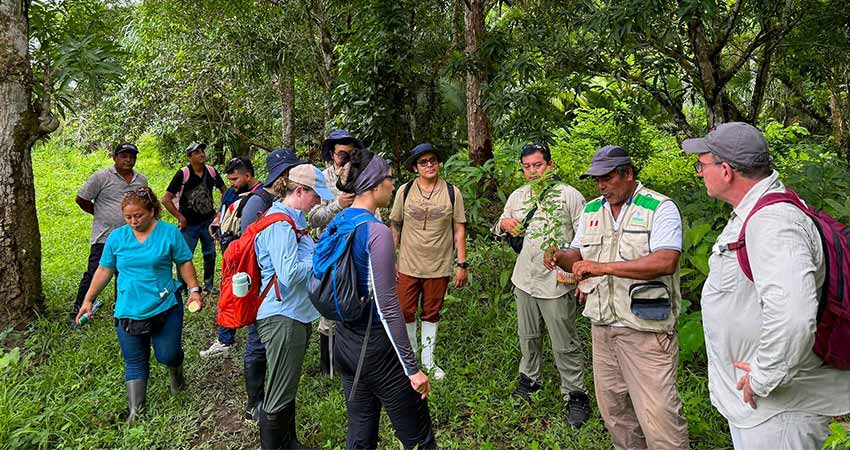
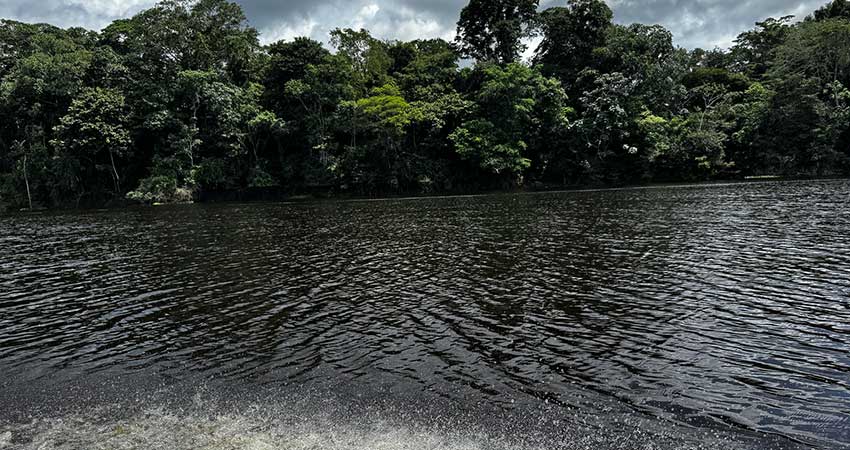
This winter break, led by MIT D-Lab Associate Director for Research Kendra Leith, we spent 16 days in the Peruvian Amazon—days measured by river crossings, shared meals, and long conversations under the forest canopy. Working in an extremely remote and resource-constrained context, our team partnered with local NGO Amanatari, Universidad de Ingeniería y Tecnología (UTEC), Diversa, and Indigenous communities to understand how climate change is reshaping forest ecosystems and livelihoods, and how bio-business development might support both standing forest protection and dignified local incomes.
Rather than a single project outcome, what stayed with me most was a shift in perspective: development work in the Amazon is less about introducing solutions and more about making visible what communities already know, value, and practice. The forest is not a backdrop— it is an active economic, cultural, and climatic system, and people’s lives are deeply entangled with its rhythms.
Community-led engagement in practice
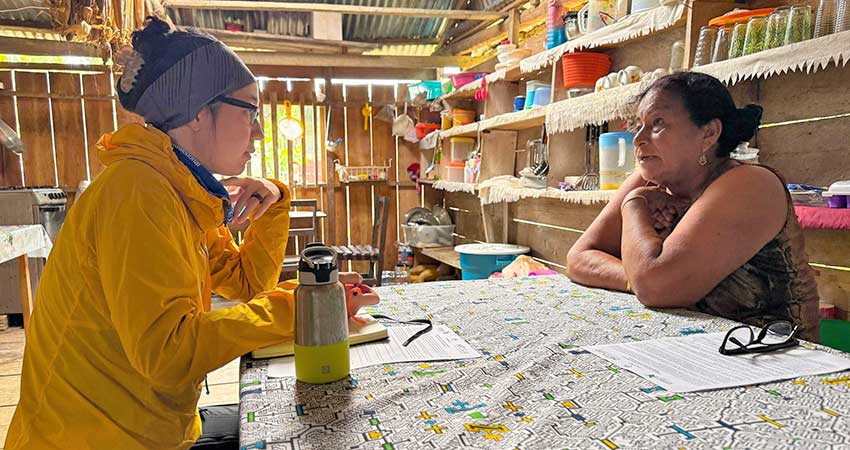
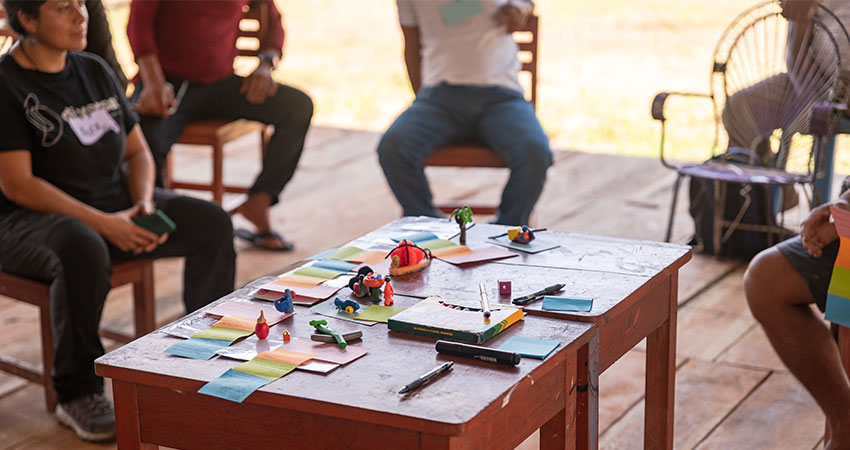
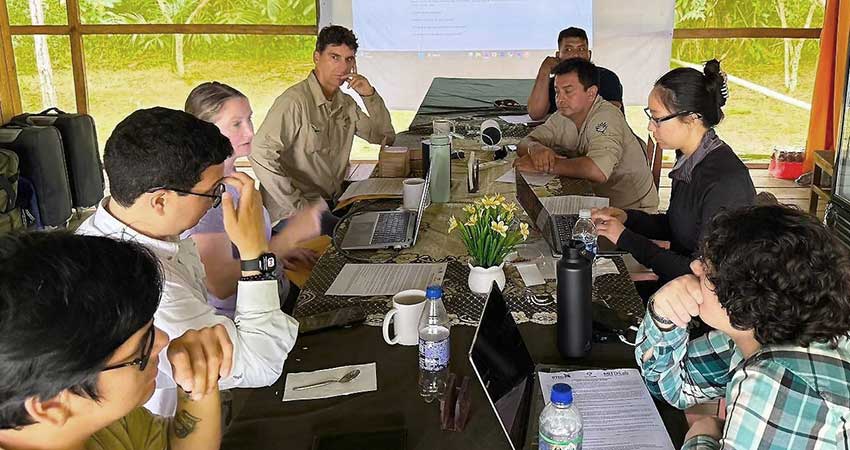
In collaboration with local partners, we conducted community-led engagement across three Indigenous communities. Over the course of the trip, we carried out more than 50 semi-structured interviews, facilitated a women’s focus group, and co-hosted a two-day participatory design workshop with over 25 community members. These were not extractive data-collection exercises; they were conversations shaped by trust, translation, and patience.
A key lesson from the D-Lab: Gender and Development I took last semester—focused on community-led design and field research—was the importance of listening before framing. We applied tools from the course such as stakeholder mapping, open-ended interview protocols, rapid gender analysis, and co-design methods that position community members as experts of their own systems. In practice, this meant letting conversations wander, honoring stories that did not fit neatly into our initial research questions, and continuously adapting our methods based on community feedback.
One moment that crystallized this for me came during a women’s focus group. While we initially framed questions around income and market access, the conversation quickly shifted toward safety, child care, and the physical toll of forest labor. That shift fundamentally changed how we understood livelihoods in this context—not just as economic activity, but as a web of care, risk, and resilience.
The Aguaje value chain: more than a superfruit
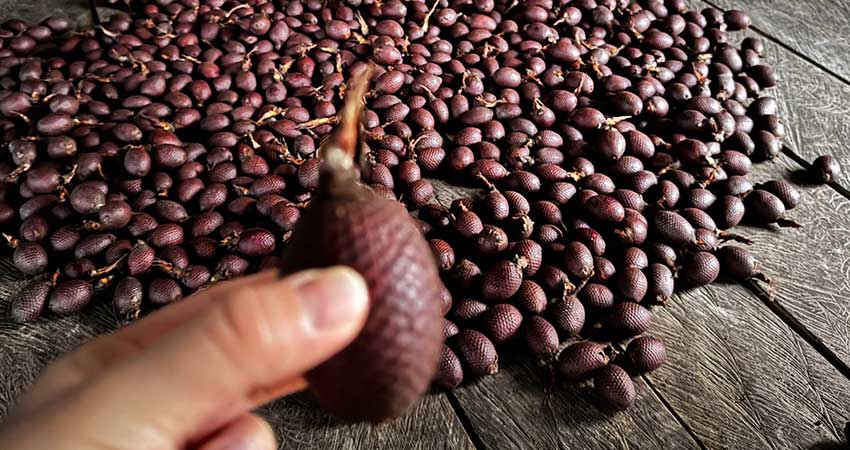
Much of our technical work centered on the aguaje palm, often called a superfruit and increasingly recognized for its role in carbon sequestration. Working side by side with community members, we mapped the aguaje value chain—from harvesting and processing to transport and market access—and conducted a SWOT analysis to inform potential bio-business strategies.
What emerged was a nuanced picture. Aguaje holds economic promise, but it also raises questions about sustainability, gendered labor (women are often central to processing), and long-term forest health. Community members spoke candidly about challenges: freeze during winter, supply exceeding demand, limited infrastructure, illegal harvesting risk, etc.
Here again, lessons from D-Lab proved critical. Rather than treating the value chain as a purely technical diagram, we approached it as a social system. Power dynamics, informal norms, and ecological constraints were just as important as prices and logistics. This reframing helped ensure that any proposed interventions remained grounded in local priorities rather than external assumptions.
Humility as method
Fieldwork in the Amazon reinforced something that is easy to say but harder to practice: humility is not just a value, it is a method. Working in contexts shaped by deep local knowledge and long histories of external intervention required us to slow down, question our assumptions, and remain open to learning at every step.
Our local partner, Amanatari, provided essential leadership, cultural translation, and deep contextual knowledge. Their relationships with the communities shaped every aspect of the work, from how meetings were convened to how findings were interpreted. This trip would not have been possible without their expertise and care.
I am also deeply grateful to MIT D-Lab, whose pedagogy emphasizes co-creation, reflexivity, and ethical engagement. I want to thank our instructors Libby McDonald, Sally Haslanger, our trip leader Kendra Leith, and Toddy Holmes, MIT Program Manager for International Safety and Security, for their guidance before, during, and after the fieldwork.
Looking forward
Leaving the Amazon, I carried with me more questions than answers—and that feels right. The experience challenged me to rethink what impact means in climate and development work. Sometimes impact looks like a polished report; other times it looks like creating space for communities to articulate their own visions for the future.
This trip reinforced my commitment to community-led design, to standing forests as living systems, and to development practice rooted in listening and respect. The Amazon is often framed as a global resource. What I saw instead were local futures—carefully navigated, deeply relational, and worthy of being led by the people who call the forest home.
About the author
Sunny Jiang is a Master in Public Policy candidate at Harvard Kennedy School. Her work focuses on sustainability, gender, and education at the intersection of development and social equity. She has worked with international organizations and non-profits across Latin America and Caribbean and Asia- Pacific, and is particularly interested in community-led approaches to development.
More information
MIT D-Lab class D-Lab: Gender and Development
Contact
Kendra Leith, MIT D-Lab Associate Director for Research