

Introduction
My name is Dharma Chari-Letts, and I am an undergraduate Mechanical Engineering student currently engaged in a summer UROP at MIT D-Lab with D-Lab Research Scientist Dan Sweeney as my supervisor.
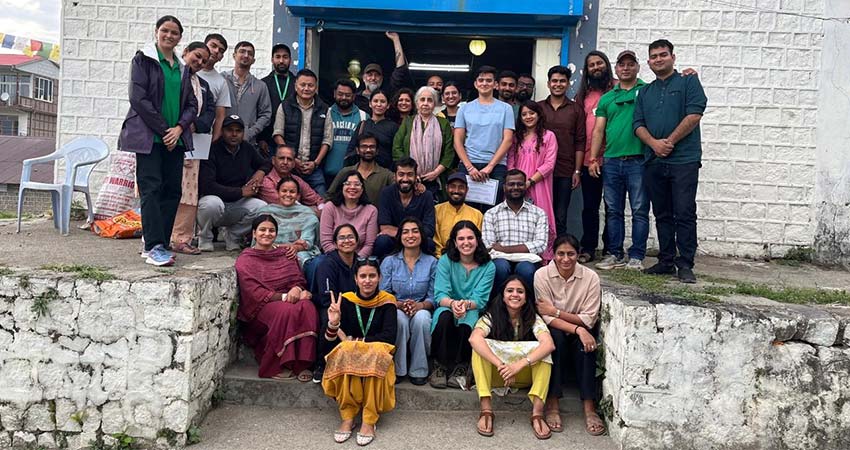
In May, I traveled to Bir, Himachal Pradesh, India, for a week-long Creative Capacity Building (CCB) training program in partnership with Waste Warriors, "an inclusive, participatory, and sustainable solution for waste management in the eco-sensitive Indian Himalayan Region." CCB is D-Lab's signature design training and this was my first experience with the curriculum. The CCB, led by longtime D-Lab colleague Alex Freese, Co-Director of Diversa in Bogota, Colombia. This CCB workshop focused on developing community-led environmental solutions through design and local entrepreneurship and I got to be both a participant and assistant.
This collaboration built on an existing relationship between MIT D-Lab and Waste Warriors established last fall. During MIT's Independent Activities Period (IAP) in January, D-Lab Associate Director for Practice Libby McDonald led students from the classes D-Lab: Development and D-Lab: Gender and Development to Bir to work with Waste Warriors and conduct an initial CCB workshop.
The problem
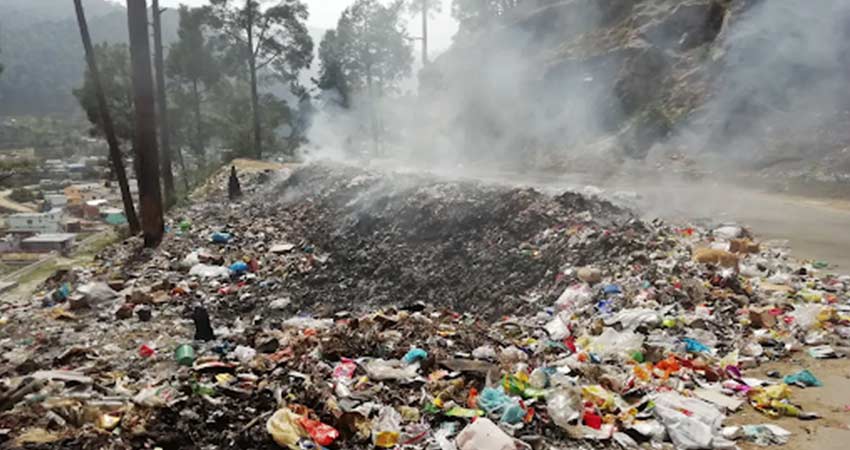
Plastic is polluting the breathtaking Himalayas. India generates 9.5 million metric tons of plastic every year. Waste is dumped, ending up in forests and waterways, endangering local wildlife and leaching microplastics. It is also burned, releasing greenhouse gases and carcinogens.
Bir, Himachal Pradesh, India, is a community in the Indian Himalayas. 40 years ago, waste management was not needed. Individual homes were completely self-sufficient because food waste was fed to livestock, and there was no plastic waste to manage. But over time, plastic has seeped into the community. Since Bir hosted the Paragliding World Championship in 2015, the small Himalayan community has been flooded with tourists who have brought a massive influx of waste.
The Waste Warriors Society stepped up to the challenge of combating the waste crisis. They started a door-to-door collection service where households can pay to have their waste taken away. They pioneered a major attitude shift, with 60% of the community now opting into their services.
Our mission
We partnered with the Waste Warriors, University of Petroleum & Energy Studies (UPES) Dehradun, Uttarakhand, India, and Royal Enfield to tackle the following problems:
1. There is no good solution for the disposal of disposable menstrual sanitary waste.
- Waste Warriors do not have the current capacity to collect it, so it is either dumped or burned.
2. MLP plastic is very difficult to recycle.
- There are two main types of plastic: Polyethylene terephthalate (PET) (used in plastic bottles) and multi-layered plastic (MLP) (used in potato chips packaging). PET plastic can be melted down and reused for different products, but MLP plastic disintegrates when it is melted.
3. Forty percent of the population is dumping or burning their waste.
- There is no way to report dumped plastic or burning sites.
Projects from the May CCB
Locally Made Cloth Sanitary Pads
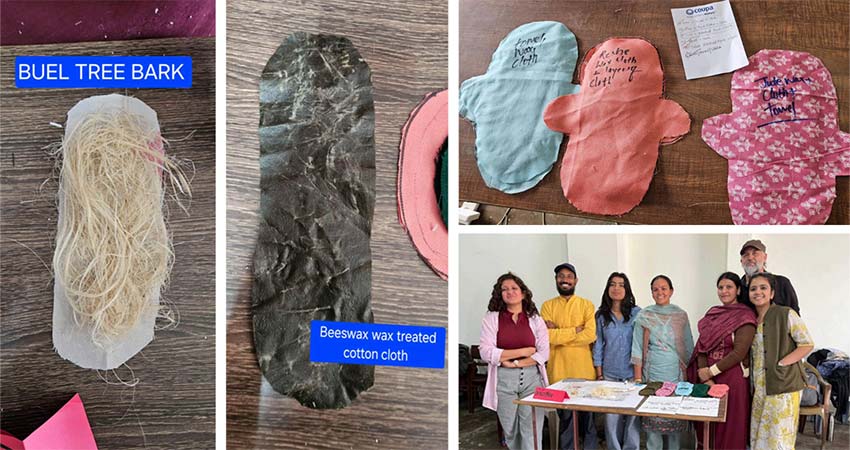
Disposable saintary pads are difficult to handle and generate waste, hence the idea of cloth pads. This is a local production of hygiene products that uses natural materials suited to the community's knowledge and environment. The team made three variants for the prototypes.
- Variant 1: cotton + buel bark sheet + beeswax infused cotton + cotton layer
- Variant 2: cotton + hemp or bamboo fleece + waxed cotton
- Variant 3: cotton + cotton fleece/flannel + waxed cotton
Eco Bricks
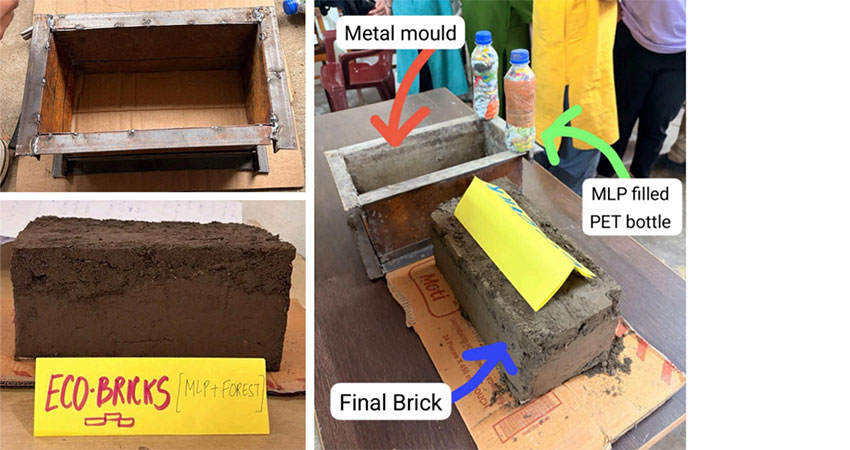
MLP waste is littered throughout the Himalayan environment. The idea behind this project is to cover the waste and prevent leaching. The team collected MLP waste, shredded and compressed it into a PET bottle, and then embedded the bottle inside the CSEB (Compressed Stabilized Earth Blocks) brick, leaving a 5cm gap all around to prevent leaching of MLP plastic. These bricks can be easily used to make single-story load-bearing structures or multiple-story framed structures. In their prototype, they were able to use up 40 grams of MLP in the PET bottle.
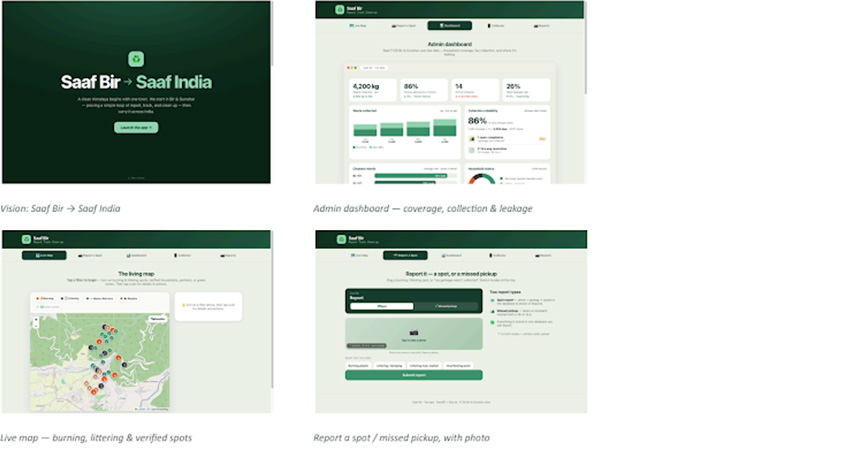
Saaf Bir Billing Mobile App & Website
To create a sense of accountability, this community-driven platform enables citizens to report waste (dumping sites, litter hotspots, overflowing dustbins), track the status of reported issues, participate in clean-up activities, and promote sustainable solutions. Link to website
Final thoughts and next steps
Overall, this Creative Capacity Building project was very inspiring. A big thank you to our partners Waste Warriors, Royal Enfield, and UPES. We look forward to turning these projects into businesses that have a positive impact on the Bir community.
For the remainder of the summer, I will be supporting all the teams in turning their projects into businesses, with a technical focus on Eco-Brick and Sylica (a glass crusher that was developed in the IAP CCB).
For more photos, visit this album!
Mentors
- Dan Sweeney - MIT D-Lab Research Scientist
- Alex Freese (Design Team Facilitator) - Diversa Co-Founder and Co-Director
- Libby McDonald - MIT D-Lab Associate Director for Practice
Works cited
Kikken, Natalie. “India generates 26000 tonnes of plastic waste every day. This is how we reduce that number.” CSIRO, 7 December 2023, https://www.csiro.au/en/news/All/Articles/2023/December/Circular-Economy-Roadmap-India. Accessed 26 June 2026.
Kumar, Vishal. “Photo essay: Why the Himalayas are drowning in waste.” Waste Warriors, 22 July 2022, https://wastewarriors.org/photo-essay-why-the-himalayas-are-drowning-in-waste/. Accessed 26 June 2026.
Waste Warriors. “Our Work.” Waste Warriors Society, 2012, https://wastewarriors.org/our-work/. Accessed 25 June 2026.
More information
Designing solutions for waste management in Uttarakhand, India, student blog post, Feb 27, 2026
MIT D-Lab Class: D-Lab: Development
MIT D-Lab Class: D-Lab: Gender and Development
Contact
Libby McDonald, MIT D-Lab Associate Director for Practice
Dharma Chari Letts, MIT Mechanical Engineering student