
AC Hacking is a project that focuses on the potential generation of drinking water from AC unit condensate, as a means of fulfilling drinking water demand in water-scarce climates.
MIT D-Lab class
D-Lab: Water, Sanitation, and Hygiene (EC.715/11.474) - Spring 2026
Partners
AC Hacking is a project completed in coordination with Cynthia Acquaye, a PhD student from TU-Delft. Her advisors, Doris van Halem, Guus Wiersma, and Rolf Hut, supervised the project.
Country
Ghana
Team members
- Gabby Bashizi, MIT DUSP (Course 11) 2027
- Alisa Webb, MIT AeroAstro (Course 16) 2028
- Erez Fass, MIT Mechanical and Ocean Engineering (Course 2-OE) 2028
Project description
AC Hacking is a project that explores the potential of AC units to generate clean drinking water. Through mapping the suitability of this solution and investigating the production of condensate in a commonly used unit type, this project hopes to demonstrate the potential of this solution. The area of study is Accra, Ghana, selected for its climate and water accessibility issues. Accra is an ideal case study for this solution to water demand issues. This project maps temperature, humidity, and precipitation in the study area, and investigates areas with probable high AC unit use to determine the areas best suited to deploy the project. It also develops a framework for modifying the AC units to strike a balance between cooling capacity and drinking water production. The project's conclusion includes brainstorming for water quality management in this particular solution, and the results include plans for implementation.
Problem framing
To ensure access to water and sanitation for all is a sustainable development goal (SDG) established by the United Nations to increase water-use efficiency throughout various sectors, as well as to address water scarcity concerns for water-stressed populations. This project seeks to address the problem of water scarcity in urban environments through the adaptation of common technology for the production of drinking water on premises.
Cultural and/or market context
The project is intended for implementation in Ghana, a country located in West Africa on the Gulf of Guinea. In Ghana, particularly in our study region of Accra, the primary source of drinking water is water sachets, small disposable plastic bags with filtered water. This source of water produces high amounts of plastic waste and is expensive, and represents a lack of access to drinking water in the household. In Ghana, as well as many other water-scarce nations, access to water is a huge barrier to both sanitation and hygiene and quality of life. This solution seeks to fulfill a part of the drinking water demand in Ghana, which will allow easier access to water and alleviate the burden of water scarcity on households.
Competitive analysis
Two direct competitors that treat water directly from AC units include Future AC Water System, based in South Florida, and US Water Systems. Both companies offer services over $1000 (USD) to install or provide technology that may transform collected water condensate into drinking water. Our project aims to provide a fundamental background to enable low-cost solutions to enable this water transformation.
Solution
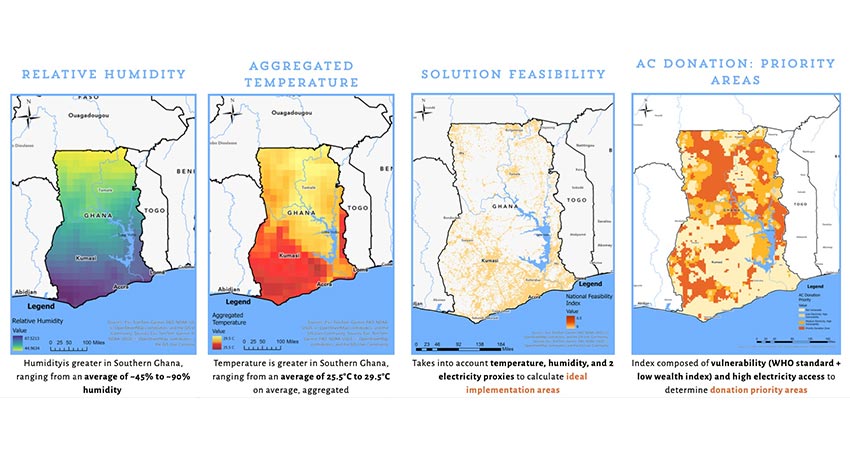
Our primary objective with this project is to enable the future development of low-cost solutions to transform collected water condensate from AC units commonly used in Ghana into consumable drinking water. To facilitate this, we produced visual maps to indicate the need and utility of atmospheric water harvesting techniques in humid climates, where annual temperatures will continue to increase as a consequence of climate change.
These maps consist of:
- Monthly Average Precipitation
- Monthly Average 2m Air Temperature
- Monthly Average Humidity
- Electricity Usage in Accra (if data is available)
- Income Distribution in Accra
- Gated Communities in Accra
- Water Distribution Networks in Accra
The maps were created via Geographic Information Systems (GIS) software. Additionally, a model was developed based on psychometric equations to model produced water condensate as a function of input temperature and humidity, desired output temperature and humidity, and the AC unit’s coil temperature. An AC unit was tested to calibrate the model and modifications to the unit.
Next steps
The mapping results of this project will be delivered as a poster and report to Cynthia Acquaye in support of her further PhD research at TU-Delft. The water condensate model and the results of the physical AC Hacking experiment will be shared as well. Future work will include the creation of physical low-cost prototypes.
More information
Contact
Gabby Bashizi, Student Team Member