
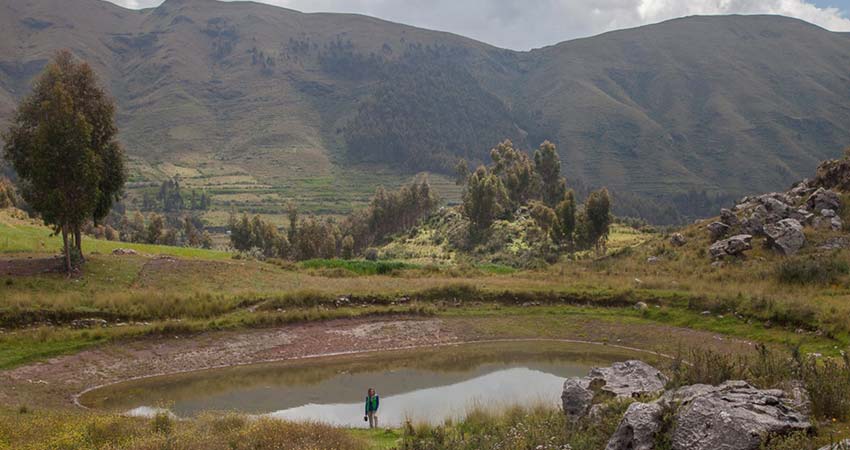
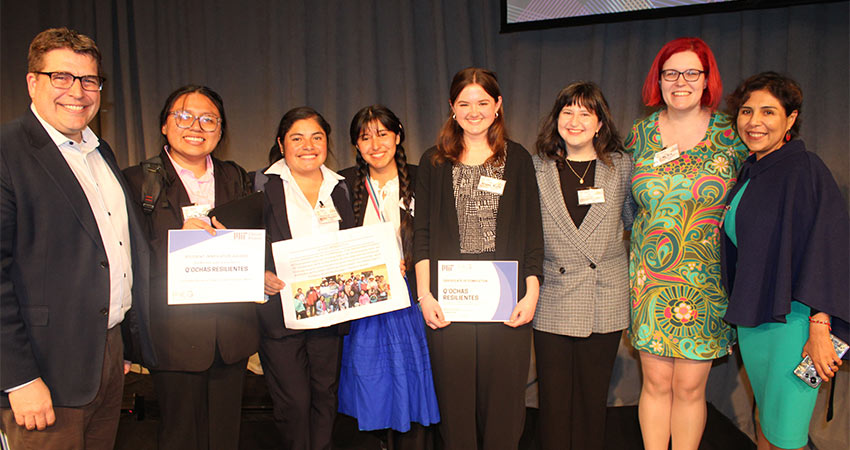
Q’ochas Resilientes works with the Pucachupa community in the Peruvian Andes to design climate-resilient q’ochas (rainwater reservoirs) using co-design methods, hydrological modeling, and a commitment to community sovereignty and land stewardship.
MIT D-Lab class
D-Lab: Water, Sanitation, and Hygiene (EC.715/11.474) - Spring 2026
Community partners
- Q'ochas Resilientes, Kathleen Julca, Founder and Co-Director
- Pucachupa community members
- Junta de Administradoras de Servicios de Saneamiento
- Pro-DIA
- UTEC (Universidad de Ingeniería y Tecnología)
Project location
Peru
Team members
- Chase Vanias, MIT Class of 2027. Chase is a student researcher majoring in computer science and neuroscience, onboarded onto the project for comparing hydrological modeling tools in order to measure the water benefits of traditional Andean q'ocha infrastructure.
- Lio Mathurin, MIT Class of 2026. Lio is a graduate student in urban studies and planning, majoring in international development. They are sensitive to issues of decoloniality and ecology and are participating in the redaction of an article touching on the importance of promoting Andean knowledge and scholarship.
- Emmanuel Kel, Ed. M, Harvard Graduate School of Education – 2026. Emmanuel Ojengwa is an Ed.M candidate in Education Leadership, Organizations, and Entrepreneurship at Harvard Graduate School of Education, with a background in Microbiology and a Master’s in Science Education (Chemistry Education). His work focuses on culturally responsive STEM education and community-centered approaches to water and environmental challenges.
Project description
Communities in the high-altitude Andes of southern Peru are actively dealing with water scarcity. Glaciers are retreating, dry seasons are getting longer, and rainfall is less predictable. In Pucachupa, a farming and herding community in the Puno-Cusco corridor, this threatens both food production and drinking water.
Q’ochas are shallow, hand-built earthen ponds that communities have used since before the Inca era to collect rainwater and let it seep into the ground, slowly releasing water through the dry season. They are low-cost and culturally familiar, though the skill to build them has gradually been forgotten. There is no reliable method for measuring how much water they actually contribute, which makes it hard to make the case for investing in them at scale.
Cultural context
Archaeological evidence places large q’ocha complexes around Lake Titicaca in the Puno region, and the practice of building and maintaining them has been passed down through generations of agropastoral communities. This project maintains close connections with the community it serves, with our project members having direct ties to the community through family or by being residents. A critical gap lies in how knowledge is shared, who controls it, and how communities participate in decision-making, particularly around water data (collection, use, and dissemination). This project reframes water challenges not only as technical issues, but also as communication, education, and equity challenges.
Approach and solutions
The project is building a low-cost monitoring and modeling system to quantify how much water q'ochas store, recharge, and release. The team selected the HBV model as the hydrological framework, chosen for its performance in data-scarce Andean catchments and its modular structure, which allows a q'ocha-specific reservoir module to be added on top of the standard soil and runoff routines. Work this semester focused on defining the field inputs and calibration parameters needed to run the model, researching durable low-cost sensors for cold high-altitude conditions, and designing a self-managed data system that the team can maintain without coding experience. A field deployment is planned for June to install sensors at a site in the Puno-Cusco corridor and begin baseline data collection.
Moreover, because of persistent injustice and the increasing demand for climate solutions, a side of the project is to create a framework that uplifts Indigenous governance and supports regenerative solutions, while providing a pathway for other collaborators to invest in and support the success of Indigenous climate innovations. The writing of an article on these methods and their history will contribute to a wider discussion of Indigenous relational ethics, ethical qualitative research, and place-based innovations, defining how to decolonise research within traditional Andean thought.
Additionally, a structured co-design workshop model has been developed to engage with Pucachupa residents, integrating basic water science, Indigenous knowledge, and local practices, and to design co-created communication models to address knowledge-sharing discrepancies. A data sovereignty learning module, comprising a simulation, a video, and a communication toolkit, will create a space for expression, agency, and collective decision-making by reflecting on issues of trust, power, governance, and transparency. Another workshop will include immediately employable skills such as microbial contamination testing, explanations of water treatment methods, and improving leadership in water management.
Next steps
The team is working toward a pilot q’ocha design, water-monitoring results, and six community events covering co-design, monitoring training, and ecological knowledge-sharing. Ten community interviews are in progress, contributing to a documentary also called Q’ochas Resilientes. A field visit is planned for Summer 2026, where the team will install the monitoring equipment, document site characteristics, and begin baseline data collection needed to calibrate the HBV model and quantify how q'ochas store, recharge, and release water.
Contact
Q'ochas Resilientes Team
- Shaela Sageth, Media Production and Indigenous methodologies
- Alison Rufo, Water monitoring and community engagement
- Kathleen Julca, Founder and Co-Director
![More than 30 from MIT [including a D-Lab: WASH alumna and D-Lab Scale-Ups Fellow] named to Forbes 30 Under 30 lists](/sites/default/files/2018-12/Forbes%2030%20under%2030_0.jpg)