

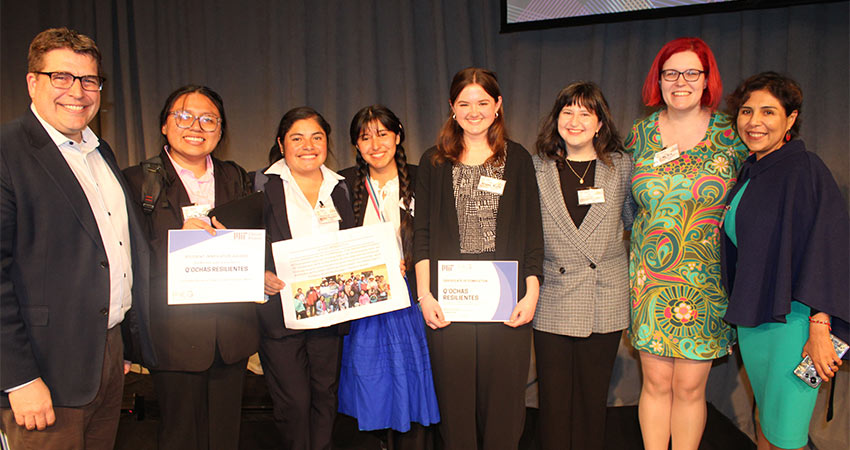
On Wednesday, April 15, at the 25th IDEAS Social Innovation Challenge, Q'ochas Resilientes won one of the inaugural $15K MIT Climate Project Student Innovator Awards presented by Shane Kosinski, Executive Director for Energy and Climate at MIT. The Q'ochas Resilientes team, lead by co-directors Kathleen Julca '25 and Stephanie Geraldine Lesslie Edith Gavilan Chino, also included MIT sophomore Alison Rufo and Universidad de Ingeniería y Tecnología (UTEC) student Lucia Viviana Diaz Garcia. The project seeks to address the looming water shortages created by climate change faced by Andean agricultural communities.
Q'ochas Resilientes first came to D-Lab through Kathleen, who was a student in D-Lab: Water, Sanitation, and Hygiene in spring of 2024. Kathleen proposed that a student team from the class form around a project she then referred to as Pucará Project. With a strong team in Peru, the project advanced through the D-Lab class and fieldwork, with funding from the MIT PKG Center and MISTI, and through the contributions of D-Lab UROP Alison Rufo with oversight from Libby Hsu, D-Lab Associate Director of Academics and Professor Ursula Rodriguez of UTEC.
Tackling climate change using ancestrally-grounded methods
Typically, residents of Pucachupa, a small community high in the Andes are subsistence farmers - what they grow and raise is what sustains them throughout the year. In 2023, when a severe drought hit the area, the aquifer was depleted, food prices skyrocketed, and animals, which had been cared for and nurtured from birth were dying or being sold for extremely low prices due to the animal-feed and water shortage in the region.
One approach to addressing these severe water shortages is to revive interest in q'ochas, ancient reservoirs which collect and store spring and rain water. The practice of creating q'ochas is estimated to be more than three thousand years old, and they are considered to have been an important foundation for life in the region. Today, with climate-change-driven drought adversely affecting the region, revival of this traditional water collection and storage method is more important than ever. Why? because q'ochas:
- replenish the aquifer supporting spring resilience
- enhance soil moisture for farming
- provide water for livestock
- generate microclimates and biodiversity
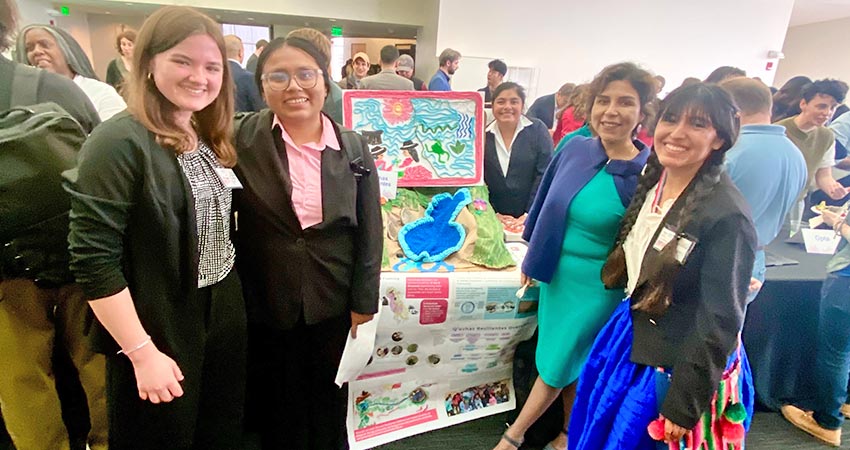
Q'ochas Resilientes proposes a model of water collection and storage based on traditional q'ocha designs that is scalable, sustainable, affordable, family-owned, and critically, one that honors the sacredness of land, water, and memory. Working closely with the community through co-design workshops, the ultimate goals are climate-adapted q’ochas designed by community, as well as case-specific water governance and labor protocols for maintenance.
More information
Q'ochas Resilientes slide deck
Contact
Libby Hsu, MIT D-Lab Associate Director of Academics
Kathleen Julca, Q'ochas Resilientes Co-Director