

Original article on the Arkansas Democrat-Gazette
KEO -- The cause of rising fish deaths at Keo Fish Farms during summer wasn't immediately clear, but Seth Summerside suspected it had something to do with years of declining water quality.
"We had seen that our water quality had just gotten a little bit worse every year and we really just called a time out, and took actual samples to see how bad it was getting, and there was one thing in particular, it was the iron issues that we have at the farm," Summerside said.
Keo Fish Farms, Inc., a 1,000 acre commercial hatchery, produces hybrid striped bass fry and fish fingerlings for stocking, as well as sterile triploid grass carp for stocking. Summerside is chief executive officer of the hatchery business.
Testing the samples showed elevated iron levels in the groundwater, which was causing the health of the fish to decline in peak summer conditions.
In 2024, Summerside asked D-Lab at the Massachusetts Institute of Technology to help to find a solution to the water issue.
"I've had good working relationships with universities, and I did research on top universities with water experience and MIT D-Lab came up specifically," Summerside said.
"I explained what we're going through at the farm and how it could be a collaboration. ... I wrote a brief and presented it to their group and they loved the idea, so we kicked off from there," Summerside said.
The farm was having issues with iron in the water but also other biological contaminants in the fish.
Research at the farm was led by Kiyoko Hayano, a second-year mechanical engineering student at MIT, who assessed the farm's systems and identified steps to deal with the iron content and the biological contaminants.
MIT representatives visited for a tour of the hatchery, several neighboring farms and nearby water treatment facilities.
The farm became a living laboratory.
"We essentially did a deep dive into all of the geological tables, looked at all of the water tables in the state of Arkansas, we compared what we were doing versus what other people were doing and ultimately found a really good way to filter out the iron," Summerside said.
"It was taking us about 30 hours and now we're doing it roughly in 28 minutes, so the efficiency has gone way up so we can use less water -- and we're also experimenting on recycling some of the water because ultimately the business was growing, we were setting records every October for the last three years at the farm, but the bottleneck to the operation was the water piece. We couldn't filter enough water to inventory enough fish to ship them out."
One key need at the farm was how to use less water at a hatchery.
Many of Keo Fish Farms' wells are fairly shallow compared to neighboring farms. Summerside estimated the farm pulls well water from roughly 75 to 100 feet below the ground.
"And we're using a pretty significant amount of water, not a lot compared to a rice farmer but at our headquarters operation, I'm estimating around 150 million gallons of water a year," Summerside said.
The farm began using regenerative aquaculture practices to reduce water usage and therefore energy, which could reduce irrigation and energy costs.
"We're looking at rice biochar that we're starting to experiment with on our ponds. It's a really good way to naturally filter the water, and we're doing some testing at the farm operation right now using biochar from rice husks," Summerside said.
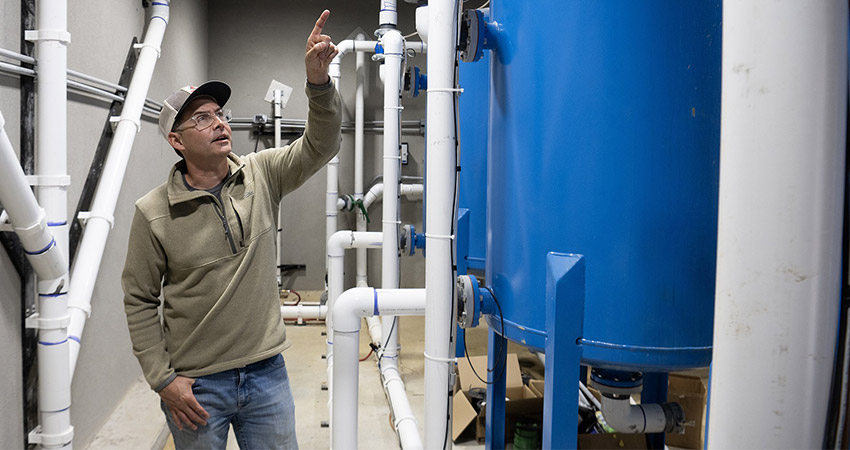
The farm also expanded its filter room.
"The water was brought up and introduced to the air, which adds an additional ion to the water, so it goes from clear to ferric," Summerside said.
MIT D-Lab was once focused almost exclusively on international missions, but has increasingly shifted to domestic projects, and there could be more collaborations with farmers in the Delta in the future, said Kendra Leith, MIT D-Lab associate director for research.
"Agriculture in the U.S. is newer for us, we've done a lot of agriculture projects abroad but not in the U.S., so we're still developing those relationships and projects," Leith said.
The lab is increasingly focusing on projects that tackle food security, domestic supply chain issues and issues with supply chains that provide food to the U.S., how to strengthen them and address their vulnerabilities, as well as addressing production challenges related to weather-related shocks and trade issues, Leith said.
"There are a lot of different places where things could break down, so how can we strengthen those weaknesses and allow for greater quality, more affordable food? It's definitely a challenge -- we're still figuring it out -- but it's something we're very interested in exploring," Leith said.
The lab wants to work more with agriculture projects and collaborate with farmers open to innovation, Leith said.
"Working with Seth, we were both in the mindset of wanting this research to be thoughtful and rigorous, but we also want it to be actionable -- and we want to make sure that the data is not going to sit in a report on a shelf, we want to make sure it's going to be picked up and used, so I think that alignment with Keo was really critical," Leith said.
More information
Exploring the promise of regenerative aquaculture at an Arkansas fish farm, MIT News, February 2026
Contact
Kendra Leith, MIT D-Lab Associate Director for Research