
Creating charcoal and biochar from the aguaje seed in the Peruvian Amazon to generate value from agricultural waste.
MIT D-Lab class
D-Lab: Design (2.722J / EC.720) - Spring 2026
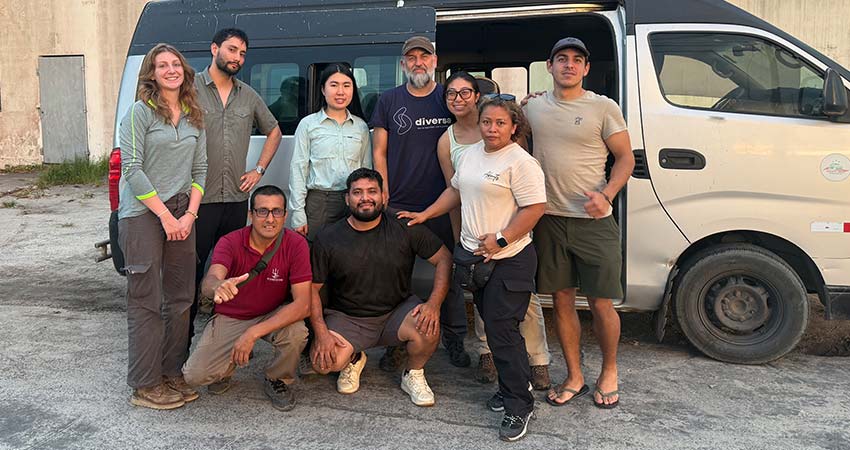
Team - Smol Ol
- Kaylee Ji (‘26) is a senior majoring in computation and cognition.
- Kyle Guerre (‘26) is a senior studying mechanical engineering.
- Megan Tian (‘27) is a junior studying computer science and math.
- Olúwatómi Ìdòwú (‘27) is a junior studying chemical-biological engineering.
Community partner
Amanatari, Vincente Avendaño, Project Manager
Project location
Peru
Problem
The Parinari community, located within the Peruvian Amazon, currently operates a local aguaje oil production business from the aguaje fruit. Currently, up to 70% of the aguaje fruit is discarded in the oil-making process. Our project partner Amanatari, a non-profit organization working with the Parinari community, expressed interest in generating value from this waste to either improve the overall quality of life within the community or create a sustainable product for sale.
Cultural context
Parinari is a remote community in the Amazon rainforest. Our project partner and the Flores brothers, who run the aguaje oil operation, hope that this waste can be turned into a product that can either be used in the community to increase quality of life or be sold to generate jobs and income for community members, with preference for the latter. They are also interested in creating employment opportunities for women who are currently difficult to employ in Parinari as they often have to take care of young children at work.
Proposed solution
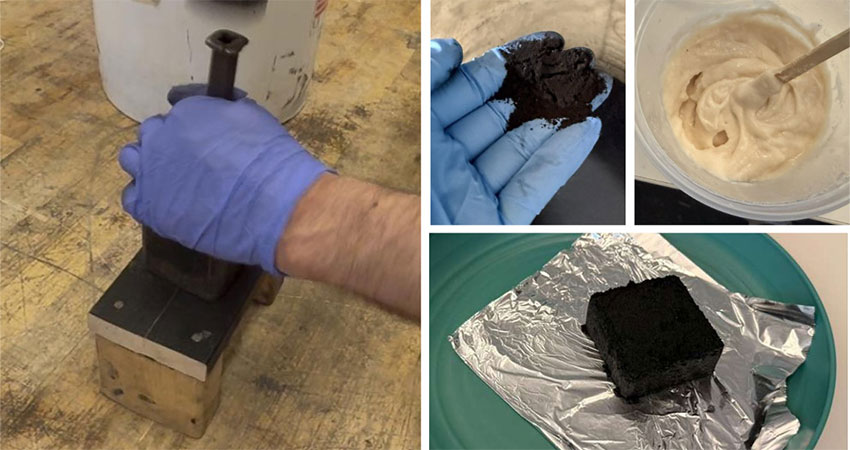
We focused on producing charcoal from aguaje seeds that can be used as a supplementary fuel source in Parinari and sold to neighboring communities. We also partnered with Megan Hung, an MBA student in the D-Lab: Smallholder Agriculture course, who worked on expanding the use of our biochar to work as a fertilizer, which can be sold to neighboring communities that rely more on farming. To ensure the charcoal is in a readily distributable, marketable form, we also tested a method for creating charcoal briquettes.
Community integration
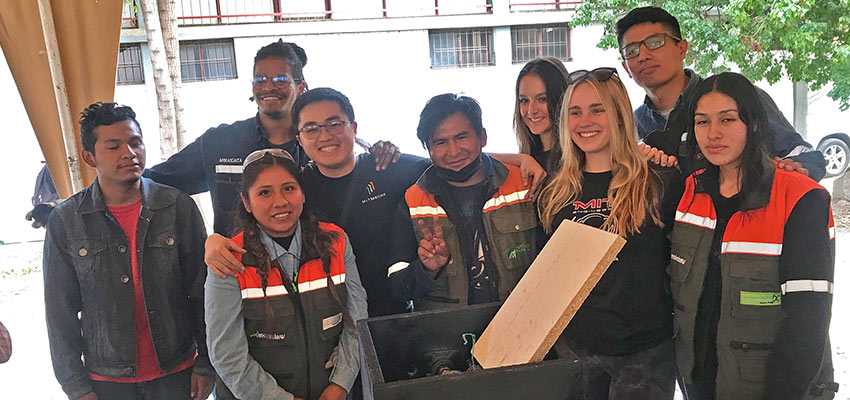
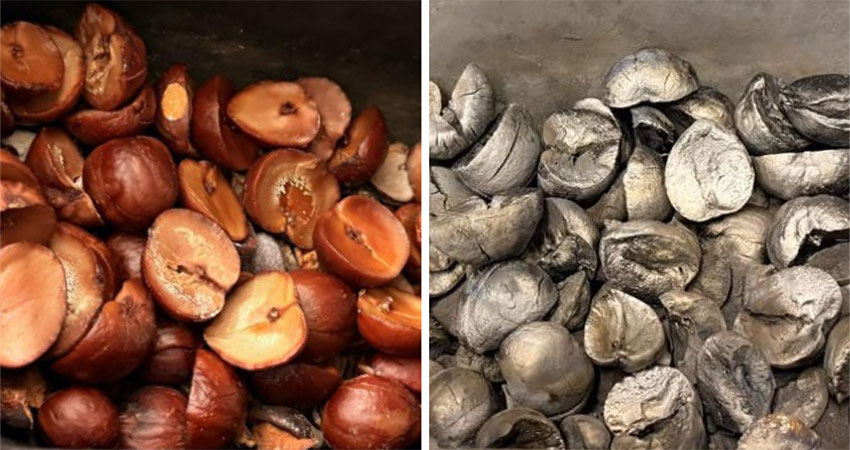
A core element of our design is the simplicity of the required resources for charcoal production to be implemented and scaled-up in a remote community. Recognizing the need for a minimally labor- intensive process to accommodate necessary breaks–enabling the employment of women in the community–we designed simple modifications to existing, obtainable tools that facilitate steps in charcoal-making process, including a grinder and press for briquette creation. Unable to acquire the aguaje seed, we designed and tested our charcoal creation process with a proxy, avocado seeds.
Next steps
Part of our team will be traveling to Parinari this summer to test, refine, and upscale our charcoal creation process on-site using the actual aguaje seed. We hope to actively collaborate with the community to brainstorm ways of turning our design into a solution that can generate lasting value for the community.
Contact
Eliza Squibb and Ankita Singh, D-Lab: Design Instructors