

3D Geometric Reconstruction and Water Balance to Estimate Water Retention in a High-Andean Qocha in Pucachupa, Puno (En español)
Abstract
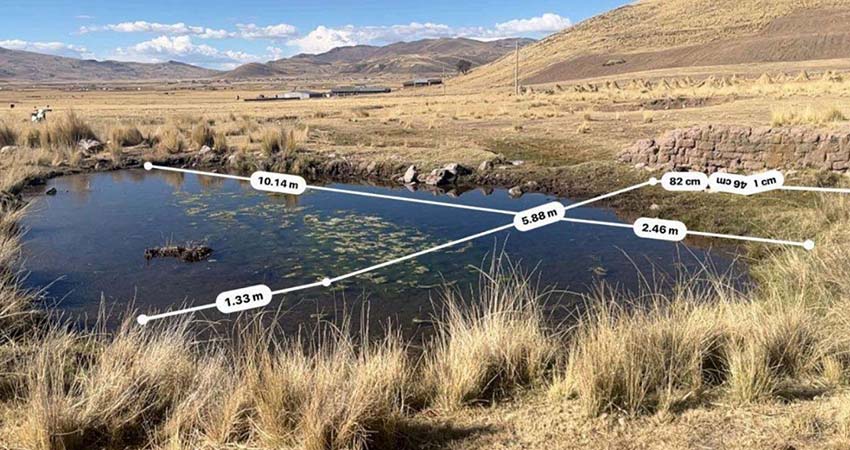
Highland qochas are ancestral water storage systems that contribute to hydrological regulation in mountain ecosystems. However, many hydrological studies represent these systems using idealized geometries, which limits the understanding of their real storage capacity. This study presents an engineering methodology that combines three-dimensional geometric reconstruction from field measurements with hydrological modeling to analyze the water retention behavior of a qocha located in Pucachupa, Puno, Peru. A computational geometric model was developed to estimate surface area and stored volume under observed field conditions. The reconstructed qocha presented an inundated area of 14.89 m² and an estimated storage volume of 5.19 m³. A simplified water balance equation incorporating precipitation, evaporation, and infiltration processes was applied to represent the hydrological dynamics of the system. Soil and environmental parameters were also measured to define the local conditions influencing water persistence. Results indicate that the qocha functions as a natural regulation system where real geometry defines the level–area–volume relationship governing temporary water storage. Because the model explicitly links reservoir geometry with hydrological fluxes, the methodology allows analysis of the system response to changes in precipitation and evaporative demand.
More information
Q'ochas Resilientes wins $15K MIT Climate Project Student Innovator Award, MIT D-Lab News, April 16, 2026
Contact
Libby Hsu, MIT D-Lab Associate Director of Academics