

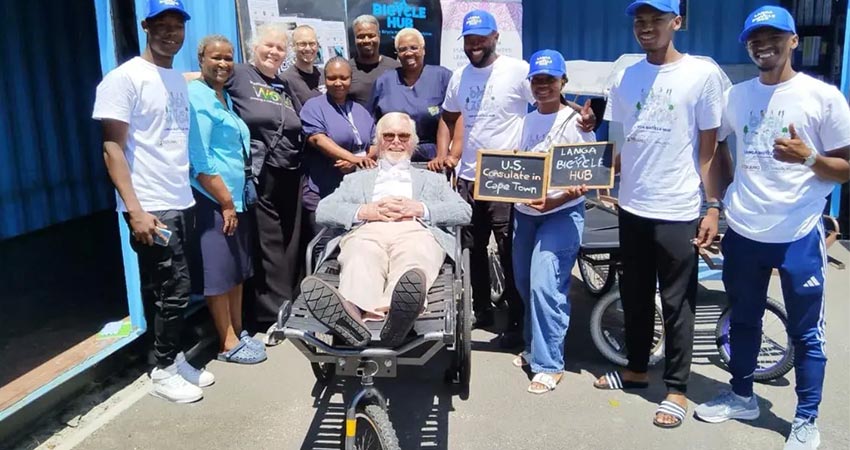
On Friday afternoon, November 13, representatives from the US Embassy and Consulates to South Africa, Leo Brent Bozell III and other delegates, visited Langa to learn more about the work being done by the Langa Bicycle Hub and its partners, including the Massachusetts Institute of Technology (MIT) and Kheth'Impilo.
The visit focused on the MIT Bicycle Stretcher, a collaborative initiative that has designed a bicycle ambulance to help transport people who need medical assistance to healthcare facilities.
The project also provided recreational and educational opportunities for the community, including cycling activities for children, bicycle tours and cycling lessons for adults who want to learn how to ride.
The initiative involves the Langa Bicycle Hub, MIT and Kheth’Impilo. It aims to improve access to emergency healthcare in areas where narrow pathways, difficult terrain, or safety concerns can prevent ambulances from reaching residents.
How the bicycle stretcher works
Langa Bicycle Hub representative Mzikhona Mgedle said the visit gave the ambassador an opportunity to see the hub’s work and could lead to closer cooperation with other organisations and stakeholders.
The delegation was shown how the MIT-designed stretcher works and how it has been improved over time.
Community health worker Yvette Andrews, who was involved in designing the stretcher, said it was developed in response to the difficulties residents face when trying to access emergency healthcare.
“Currently, it can take up to three taxi trips to get to Vanguard. The stretcher provides a free option where we can either wheel people to a point where an ambulance can collect them when parts of Langa are red-zoned, or take them directly to Vanguard if it is closer,” she said.

The stretcher is intended to complement, rather than replace, conventional ambulance services. It can help community health workers or volunteers transport patients to a point where an ambulance can reach them, or directly to a nearby healthcare facility where appropriate.
The project also aims to provide patients with a safer and more dignified alternative to being transported in wheelbarrows when emergency transport is unavailable.
In some parts of Langa, emergency vehicles cannot reach residents because of safety concerns. Narrow pathways and closely built homes in some areas can also make it physically difficult for conventional ambulances to enter.
The project hopes to strengthen its partnership with Emergency Medical Services so that paramedics can use the stretcher when ambulances cannot reach patients.
Hub offers cycling and educational activities
In addition to the healthcare project, the Langa Bicycle Hub provides recreational and educational opportunities for residents.
These include cycling activities for children, bicycle tours and lessons for adults who want to learn how to ride.
The delegation toured the hub and visited parts of the area, including the Langa Sports Complex hall. Visitors were also shown how the hub works with community health workers and City of Cape Town employees.

Bozell III said the initiative was an important example of community-driven work.
“The community desperately needs something like this. People need support, and in many ways, initiatives like this give people hope and a sense of belonging,” he said.
He said the hub created opportunities for young people through sport, knowledge and community activities.
Bozell III thanked the team and everyone involved in the project, describing their work as extraordinary.
He also said he hoped to return to Langa and take a bicycle ride through the community.