

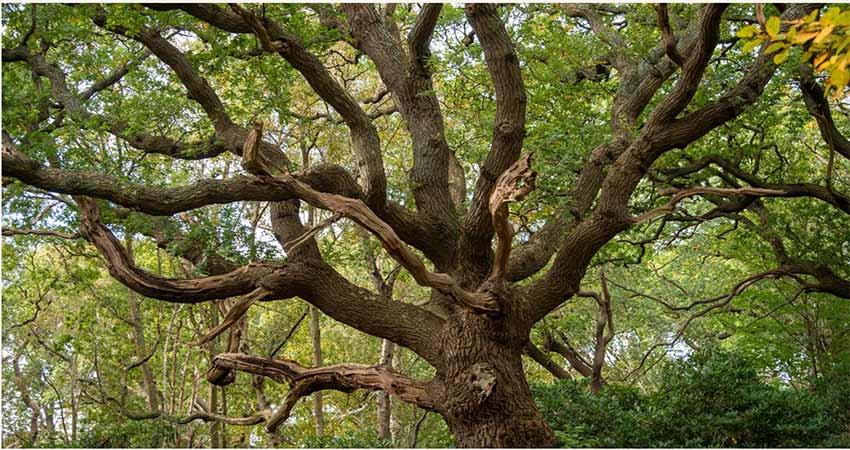
As water crises worsen in developing nations, MIT researchers discovered that nature had already engineered the solution—hidden inside tree branches that cost nearly nothing
Original article on Space Daily
Break a branch off a pine tree, strip the bark, and pour filthy pond water through the stick. What drips out the other side is far cleaner than what went in. Sounds like bush folklore, except a team at MIT published the result in a peer-reviewed journal and then spent more than a decade trying to turn the party trick into a product people could buy.
What a tree is doing when it drinks
Conifers pull sap upwards through sapwood, packed with narrow conduits running the length of the trunk and branches. Those conduits join through membranes riddled with pores only a few nanometres across, a design that evolved to stop air bubbles from snapping the column of sap. Bacteria are enormous by comparison. Wood filters water by accident.
Rohit Karnik’s lab at MIT put that accident to the test in 2014. Writing in PLOS ONE, Michael Boutilier, Jongho Lee and colleagues showed that coniferous sapwood strips bacteria from water under nothing more than gentle pressure, and that roughly three cubic centimetres of it could yield several litres a day, enough for one person.
There was a catch in that early work. The filter caught particles down to around 100 nanometres, comfortable enough for bacteria (E. coli measures roughly a micron across) but far too coarse for the smallest viruses, some of which are a fifth that size and slipped straight through.
Why dry wood nearly killed the idea
Fresh sapwood filters well. Drying breaks it, because the sieve-like membranes slump against the conduit walls and strangle the flow. The discs also gum themselves up in service, packing woody debris into the same channels the water needs.
Two thoroughly unglamorous fixes cracked it: soak the wood in hot water for an hour, then dip it in ethanol and let it dry. Krithika Ramchander, then a PhD student at MIT, found that discs treated this way kept their flow rate instead of seizing. MIT News reported they could then sit in dry storage for at least two years and still perform.
What the lab numbers actually say
A 2021 paper in Nature Communications does the heavy lifting. Ramchander, Karnik and five co-authors reported better than three-log removal of E. coli, MS-2 phage and rotavirus from spiked test water: in plain terms, at least 99.9 per cent of each, gone. Discs were cut from ginkgo, four centimetres wide, running under a gravity head of about 1.2 metres.
Rotavirus mattered most, and the numbers don’t quite add up on their own. At around 70 nanometres, it’s smaller than the roughly 100-nanometre cutoff the original pine studies reported, sitting in the size range those filters had already shown they couldn’t reliably catch. The 2021 tests used ginkgo instead of pine, and thicker, chemically treated discs, which helps, but probably not enough on its own to explain three-log removal. More likely, the virus gets trapped some other way: a longer, tortuous path through the wood, or adhesion to the pit membranes rather than simple size exclusion. It’s also the single biggest cause of diarrhoea worldwide.
One study, controlled conditions.
Real water behaved less politely than test water, though the same filters still reduced coliform counts in spring, tap and groundwater samples. Each disc weighed seven to eight grams and pushed through tens of litres before clogging.
Then they took it to India
Karnik’s group worked with MIT D-Lab, drawing on interviews and design workshops with more than 1,000 potential users across India. People had firm opinions about what they would and would not put on their kitchen bench, and made sure the researchers heard them.
That feedback shaped the hardware. Out came a simple gravity-fed unit with replaceable wooden discs, purifying at roughly one litre an hour, a rate that sounds sluggish until you notice it needs no electricity, no plumbing and no imported membrane.
The scale of the problem is unforgiving. WHO counts around 1.7 billion people drinking water contaminated with faeces, and close to 505,000 diarrhoeal deaths a year traced back to it.
The seven-day problem
Wood rots.
Dry storage was never really the problem: the two-year shelf life held up fine. Once a disc was wetted and put into daily use, it lasted only about a week, and no one found a way to extend that service life without introducing chemicals into the water it was meant to clean. DetoXyFi, the startup that grew out of the research, told ThePrint in August that this was exactly why xylem proved so hard to commercialise.
One of its co-founders, Dhananjay Goel, grew up in the hills of Himachal Pradesh, where his family stretched every bottle for drinking and shared a single bucket for washing. That’s not the kind of detail a spec sheet captures, but it’s most of the reason the company still exists.
Their current product, a tap filter called Jal Kavach retailing at 899 rupees, uses a composite membrane with activated charcoal. No pine involved.
The pitch increasingly rests on comparison rather than novelty. Reverse-osmosis units are the default in most Indian kitchens, need power and regular servicing, and by the company’s own reckoning discard about three litres of water for every one they clean. Selling a gravity filter into that market takes patience, since Indian buyers raised on RO don’t easily trust anything else.
So the branch worked and the business did not, at least not on the terms anyone expected. Sapwood is still out there, cheap, biodegradable and growing on trees, waiting for someone to solve a service-life problem rather than a physics one.
More information
Engineering and characterization of gymnosperm sapwood toward enabling the design of water filtration devices, Nature 2021
Assessment of user needs and preferences related to drinking water and water filters in Uttarakhand, India, MIT D-Lab blog post 2017
Investigating user needs preferences for a low-cost water filter while gaining life perspective and cultural meaning in India, MIT blog post 2017
Contact
Kendra Leith, MIT D-Lab Associate Director for Research